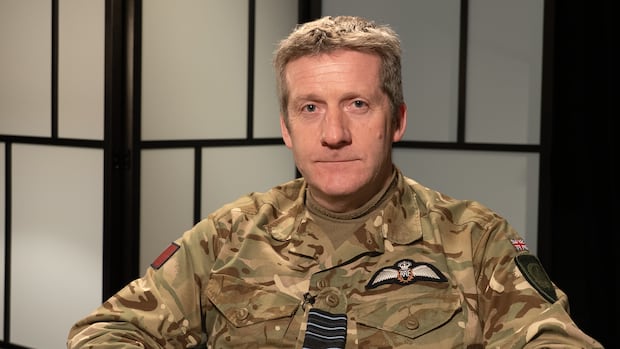
The deputy commander of NATO expressed satisfaction with Canada’s role in the Western allies’ deterrence efforts in Eastern Europe and provided measured approval on Wednesday regarding the nation’s attempts to strengthen its military forces.
In an exclusive interview with CBC News in Ottawa, British Air Chief Marshal Sir John Stringer discussed the ongoing political tensions between the Pentagon and Prime Minister Mark Carney’s administration concerning military expenditure and readiness.
U.S. Department of Defense officials have been increasingly vocal in their efforts to urge Canada to increase its defense spending in the short term, arguing that Canada is falling short of its NORAD and NATO obligations due to inadequate preparedness among its forces.
Additionally, a senior official from the U.S. Department of Defense, speaking off the record, indicated that the Pentagon is ready to “raise the stakes” on recent limitations it has placed on cooperation with the Canadian military unless Ottawa takes Washington’s concerns more seriously.
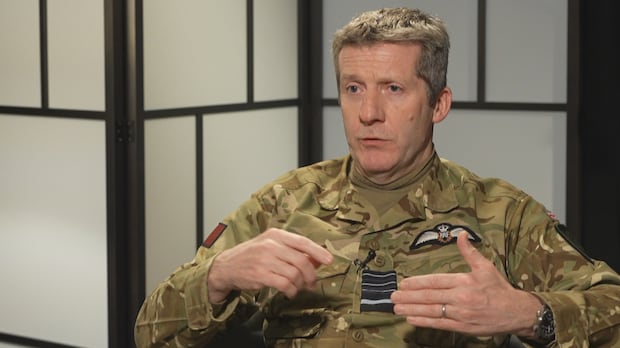
When asked by CBC News about the Pentagon’s view that Canada isn’t contributing its fair share to defense funding, NATO deputy commander Air Chief Marshal John Stringer remarked that Canada is ‘a nation that is recapitalizing its investments in its air, land, and maritime forces.’
“I won’t comment on what other countries might say,” Stringer stated.
“What I observe in Canada is a country that is deploying significant military resources to Europe, particularly with the multinational brigade in Latvia, among other contributions. I see a nation that is reinvesting in its armed forces.”
<pWhen directly questioned about his satisfaction with the readiness of the Canadian-led brigade in Latvia, Stringer replied, "I'm pleased with what I see when I look at Canada."
Currently, approximately 2,200 Canadian troops are stationed in Latvia, with plans to increase that number to 2,600 shortly.
In addition to providing a battle group, Canada leads the NATO multinational brigade, which consists of 3,000 personnel. This deployment was recently extended by Carney until 2031.
The commitment to Operation Reassurance is expected to reach $7 billion according to the latest federal budget during this period.
Stringer, who is in line to succeed U.S. Gen. Alexus Grynkewich as NATO Supreme Allied Commander Europe (SACEUR), stated that Canada is not alone in its efforts to rebuild its military and is making the necessary investments.
“Many countries experienced a moment of euphoria after winning the Cold War, which led to both physical and conceptual disinvestment,” Stringer explained.
“Now, a number of nations are increasing their military spending, and I view Canada as one of those countries that is investing wisely.”
On Monday, the Pentagon released a “fact sheet” asserting that Canada is not a reliable defense partner and that its military spending lacks focus. The report highlighted subpar readiness statistics and delays in the modernization of essential equipment.
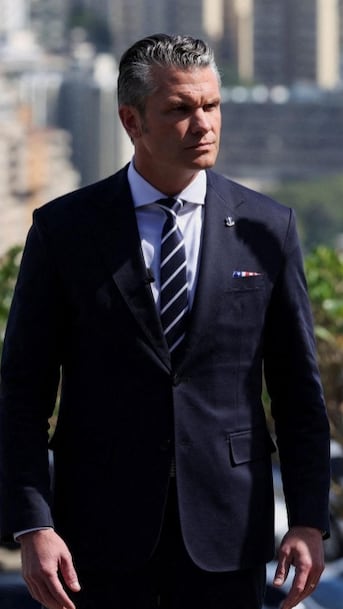
The escalating exchange between the Pentagon and the Canadian government intensified as a senior U.S. official indicated that if Canada does not concentrate its military investments on continental defense, the U.S. would begin considering ‘significant mitigation measures.’
“Ottawa’s focus on narrow economic and commercial interests over military optimization adds uncertainty for NORAD and places additional burdens on our Joint Force and American taxpayers,” stated the fact sheet.
However, Canada is not unique among NATO allies in facing challenges with military readiness, as the United States is also grappling with similar issues.
In March, the U.S. Government Accountability Office informed Congress that American military readiness had declined over the past two decades. In 2024, 25 out of 27 types of Army and Air Force aircraft failed to meet operational availability targets.
A separate audit released in June revealed that the mission-capable rate for the U.S. F-35 fleet had dropped from 67 percent in 2021 to 44 percent last year, with only 25 percent capable of executing all assigned missions.
Senior officials within the U.S. Navy reported last year that readiness across their fleet of ships, submarines, and aircraft ranged between 67 and 70 percent.
Britain, on the other hand, has chosen not to publicly share detailed military readiness statistics, citing national security concerns. Parliamentary research published this year indicated that all three branches were falling short of their trained personnel goals.
France has also limited the release of readiness data, with its 2023 figures forecasting operational availability of 69 percent for combat aircraft, 59 percent for frigates, and 87 percent for battle tanks.
Germany has classified detailed equipment readiness statistics, complicating direct comparisons with Canada’s military.
“When I consider Canada’s position in this context, it appears quite similar to many other countries,” said Stringer.
“Readiness is always an area for improvement. There’s always room to be better tomorrow than today, and that remains a focus for all nations within the alliance.”
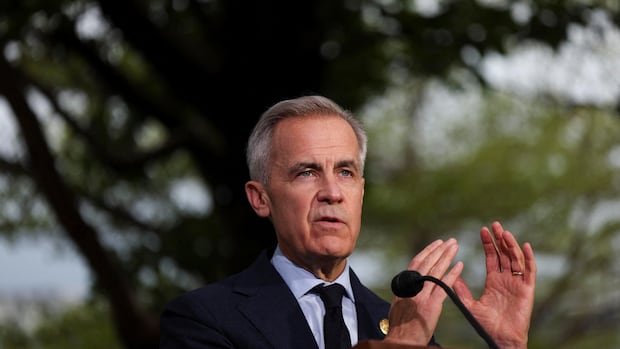
As Prime Minister Carney entered a Liberal caucus meeting on Wednesday, he addressed the situation and downplayed the controversy with the Pentagon.

In response to the Pentagon’s claim that Canada isn’t fulfilling its responsibilities regarding North American defense, Prime Minister Mark Carney stated that his recent discussions with U.S. President Donald Trump have concentrated on ‘conflict resolution around the globe.’
“I can assure you that in my conversations with the president of the United States, we have focused on global conflict resolution, and he has not raised issues as reported recently,” Carney remarked.
“Canada is taking charge of its defense. We are at the forefront of NATO’s defense efforts, particularly with Operation Reassurance in Latvia. We are collaborating with our NATO allies, including the U.S., as well as the Nordics, Germany, and France, especially in the High North and the Arctic regions.”
As Canada and the U.S. engage in discussions regarding commitment and investment, Stringer and NATO’s supreme command are concentrating on Russia’s escalating campaign of grey zone warfare in Europe.
Just last week, three Russian KH-101 cruise missiles fell in southeastern Poland during a large-scale overnight assault by Russia on Ukraine. Fortunately, there were no injuries or damage to infrastructure. One missile landed roughly 35 kilometers from where troops from 11 allied nations were engaged in military exercises to prepare for a potential postwar mission in Ukraine.
Polish Prime Minister Donald Tusk labeled the airspace breach an “intentional provocation” by Russia.
Stringer, however, was cautious in his assessment, noting that an investigation is still underway.
“We are trying to determine why they ended up there. Fundamentally… was it intentional or accidental?” Stringer told CBC News.
“And even if it was accidental, what does that reveal about the recklessness in warfare five years into their three-day special military operation?”
He remarked that Russia continuously seeks to provoke, and the challenge for NATO is how to react.
“What we do not need is to do Mr. Putin’s job for him by overreacting,” Stringer emphasized. “We must remain calm, measured, and resolute in addressing provocations. Furthermore, not every military action necessitates or even deserves a military response.”