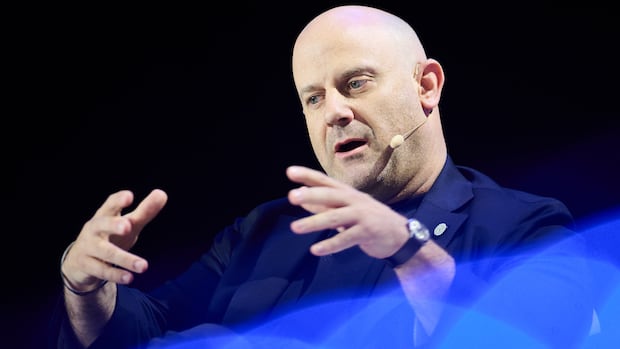
Dominion Dynamics, a defence technology firm located in Ottawa, has entered into a partnership with Telesat, a prominent Canadian satellite operator. This agreement paves the way for the creation of a domestic alternative to Elon Musk’s Starlink and its military counterpart, Starshield.
The collaboration, valued at $2.2 million, was announced on Thursday and is part of a larger initiative aimed at enhancing the Canadian military’s autonomy over the technology essential for Arctic defense.
As part of this agreement, the two companies will collaborate to create durable, portable satellite antennas designed to connect military personnel and unmanned aerial vehicles to Telesat’s forthcoming Lightspeed network of low-Earth orbit satellites.
This deal is a positive development for Telesat, especially as the company is grappling with a significant debt maturity issue. Approximately $3.1 billion associated with Telesat’s traditional satellite operations is anticipated to be due between December 2026 and October 2027.
Prime Minister Mark Carney says Canada will ‘diversify away’ from Elon Musk’s Starlink as it looks to reduce its reliance on U.S. technology. But with Canadian alternative Telesat Lightspeed still years away from full service, how difficult will that be?
Telesat management has until January 18, 2027, to restructure the legacy segment of the business, which is distinct from the low-Earth satellite division that has partnered with Dominion.
The initiative with Dominion, which includes backing from the National Research Council, aims to provide Canadian forces with a secure communications framework that is independent of any U.S. commercial carrier.
Prime Minister Mark Carney has cautioned against the risks of relying on a single technology supplier, emphasizing the significant implications this can have for national sovereignty.
Eliot Pence, founder and CEO of Dominion Dynamics, noted that events in Ukraine highlight the necessity for Canada to seek alternatives.
“Clearly, we’ve witnessed Starlink being disabled in Ukraine,” Pence remarked. “What we are creating is complementary to that [communications] infrastructure.”
The technology being developed will enable military units and drone aircraft to communicate directly through the Telesat network, which is under Canadian control.
Pence described the project as akin to Starlink’s portable satellite terminals but tailored specifically for military use in the challenging Arctic conditions.
“Imagine it as a Starlink Mini, but a Telesat Dominion Mini,” he explained. “It’s a sovereign communications link designed explicitly for the Arctic” with military specifications.
Starlink Difficult to Avoid
However, this partnership does not imply that Canada will completely move away from Starlink.
Pence indicated that the vast satellite network operated by the American company makes total avoidance challenging.
“There will need to be some interoperability with Starlink because their satellite deployment is just so extensive,” he stated.
The intention is to ensure that Canadian commanders have options in case one communications network becomes unavailable, unreliable, or politically sensitive.
Dominion’s current communication technology is capable of managing multiple networks, allowing military systems to alternate between them as needed.
The company plans to create two prototype terminals: one lightweight version for soldiers to carry in the field and a larger model for unmanned aircraft and other uncrewed military platforms.
Both prototypes will be built to withstand extreme cold and function in remote areas with limited infrastructure.
While the Canadian military is the primary target customer, no defense procurement contract has been finalized yet.
Dominion asserts that this technology could eventually be utilized by Canadian Rangers, the Coast Guard, RCMP, and emergency responders in the North.
Nonetheless, there remains a significant challenge ahead.
Governments are spending billions on the autonomous arms race — should Canada join in? For The National, CBC’s Jennifer Yoon examines the future of AI-powered military weapons, what it means for international humanitarian law and where Canada fits in.
Telesat first needs to successfully launch and operate its Lightspeed constellation. The company currently anticipates commencing commercial operations in high latitudes by the end of March 2028.
The partnership with Telesat is one of several collaborations that Dominion has announced this week as it seeks to position itself as a significant player in the swiftly growing market for autonomous military drones.
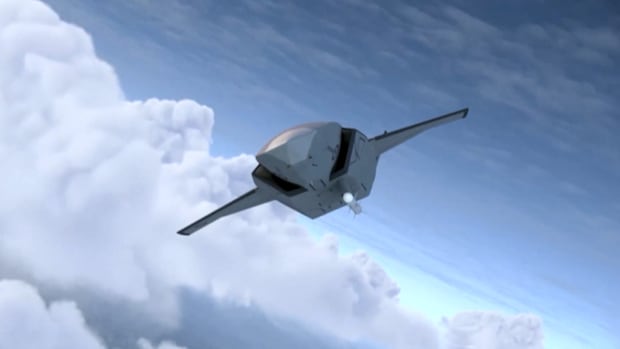
On Friday, the company revealed that, apart from developing the Telesat receiver, it has engaged the satellite manufacturer and several other Canadian firms to work on Scout, its uncrewed combat aircraft.
-
Musk says he was behind Starlink speed restriction in Ukraine
-
The age of AI warfare has dawned. Is Canada ready?
Supporting companies involved in the development of Scout include Thales Canada, Top Aces, ITPS Canada, PV Labs, SRC Can, Altitude Aerospace, Groupe DCM, HSB Solutions, North Aircraft Industries, and RAMPF Composite Solutions.
Additionally, the company announced a partnership with Pratt & Whitney Canada to supply the propulsion system for the Dominion Scout, an uncrewed combat aircraft designed to operate alongside traditional fighter jets.
Scout is intended for long-distance flights over the Arctic, conducting surveillance and possibly executing strikes against enemy targets.
The aircraft will utilize a Canadian-manufactured PW300-series engine.
Pence emphasized that obtaining an engine supplier is a crucial milestone for a project still in its development phase.
“You don’t truly have an aircraft until you secure a propulsion system,” he remarked.