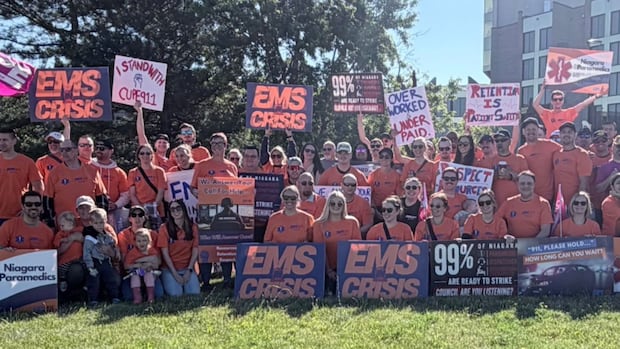
The leader of the local union representing paramedics, emergency dispatchers, and occupational therapists in Niagara has indicated that a 48-hour strike notice could be issued at any moment if an agreement with the Ontario region is not finalized.
According to Dave Barnett, president of Local 911 of the Canadian Union of Public Employees (CUPE), the union has a specific strike date in mind but is optimistic about reaching a resolution before resorting to that measure.
“We’ve selected a date in our minds, but I’m not disclosing it as it may change,” he stated in an interview with CBC News. “Everything hinges on the current environment at work, and we are prepared to issue a 48-hour notice at any time.”
Negotiations, which started in January, focus on key issues such as higher wages, enhanced mental health benefits, and guaranteed meal breaks.
In March, the union secured a 99 percent strike mandate from its members and is set to reconvene with the region on November 30.
Potential Impact on Ambulance Services
During strike actions, paramedics and dispatchers are obligated to maintain essential services.
Barnett explained that the essential services agreement allows only 14 to 15 percent of paramedics to be off duty during a strike. In Niagara, this translates to 119 paramedics on duty instead of 138, with only one emergency dispatcher permitted to leave per shift.
In a statement to CBC News, Niagara EMS chief Karen Lutz-Graul assured that the region has contingency plans ready and that emergency calls will continue to be addressed regardless of the negotiation outcomes.
“Niagara region remains optimistic about reaching an agreement with CUPE 911 and is dedicated to pursuing a resolution through the bargaining process,” Lutz-Graul remarked.
Barnett pointed out that Niagara’s geographic layout introduces a level of complexity not faced by other services. While other regions in Ontario may rely on neighboring communities for ambulance services during emergencies, Niagara’s borders and lake shores could restrict the availability of backup ambulance services during a strike.
“We’re on a peninsula, right? Nobody is crossing Lake Ontario. Buffalo is not coming to our rescue,” he explained.
Reasons Behind the Strike Threat
For Oliver Gaskin, a paramedic in Niagara since 2014, the issue extends beyond financial concerns.
Gaskin noted that 12-hour shifts often extend to 14 or 15 hours, sometimes allowing just one 30-minute meal break early in the shift.
Barnett mentioned that paramedics are entitled to one 30-minute break during a 12-hour shift, but due to high call volumes, they often miss this opportunity.
“I’m exhausted from hearing my colleagues say, ‘I feel like I’m going to collapse,’ because we prioritize helping others,” said Gaskin, who envisioned a long-term career as a paramedic.
“I just hope that the region offers us a deal that allows me to continue my career here, as I’ve reached a point where I don’t see a future for myself at Niagara EMS.”
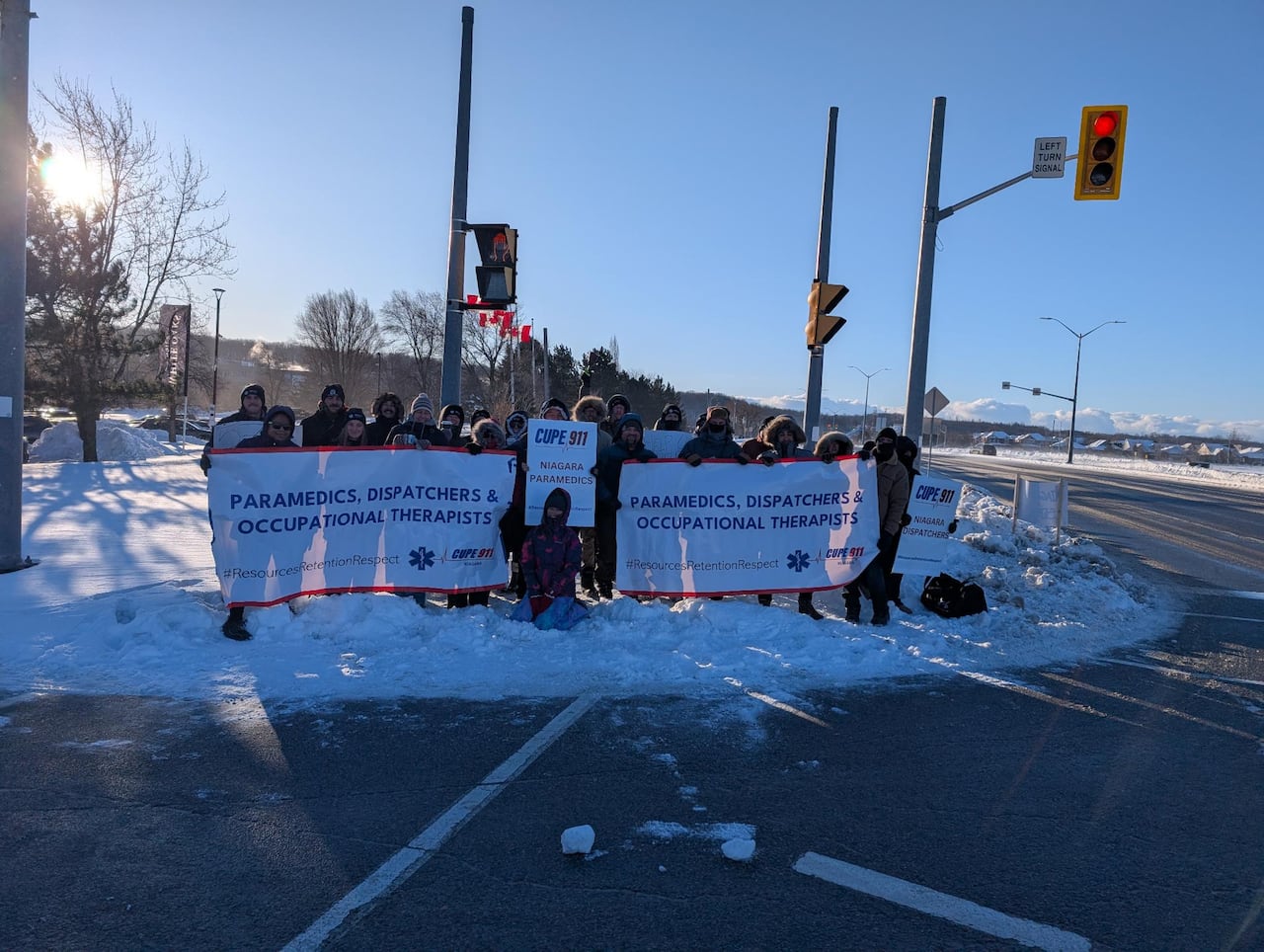
In this winter file photo, union members hold up signs as they seek a new contract. (Submitted by CUPE 911)
Discussions about mental health supports are also a significant part of the negotiations.
Anastasia Fricke, an emergency dispatcher in Niagara since 2019, shared that she often carries the emotional burden of her job home with her.
“You can hear the voices. The calls replay in your mind, and you wonder, ‘Did I do everything possible for them?'” she expressed.
Fricke indicated that dispatchers receive $3,000 each year in mental health benefits, a sum that can be quickly exhausted by therapy sessions. She advocates for increased support to help employees manage trauma proactively rather than seeking treatment after experiencing burnout.
“Sometimes, that’s all I need … just 15 or 20 minutes alone to cry it out and move on,” she described, referring to her response after a tough call. “Other times, you might need to take a few hours off or even go home.”
Barnett pointed out that mental health support is especially scarce for part-time paramedics, who receive no mental health benefits, even as some work full-time hours.
“They receive absolutely nothing,” he stated.
Perspectives on Recruitment and Retention
Barnett noted that paramedics in other regions, such as Peel, Waterloo, and Haldimand, have recently secured new contracts, while Niagara’s workers are still awaiting a deal.
At the time of speaking with CBC News, Barnett was in Peterborough supporting striking paramedics engaged in a similar dispute.
He mentioned that Niagara is losing seasoned paramedics to better-paying positions in other areas, including Waterloo and Peel. One paramedic who recently departed told him they are now earning more in a new role than they would have as a fully “waged-out” paramedic in Niagara.
On the other hand, Lutz-Graul indicated that the service is not facing challenges in retaining its staff.
She reported that voluntary turnover has remained between four and six percent each year, currently at 3.87 percent this year. Applications have surged by 12.6 percent from 2025 and 29.6 percent from 2024.
“We continue to attract a strong pool of candidates and are proud to welcome the best individuals to our team,” Lutz-Graul affirmed.
Barnett expressed concern that an increase in applications might not necessarily lead to more hires. He noted that the latest recruitment class included only 12 paramedics, marking the smallest group since 2023.
Additionally, he mentioned that over 200 individuals have joined the union since 2020, yet its net membership has only grown by around 80.
In response to the discrepancy, Lutz-Graul mentioned that the number of CUPE 911-represented positions at Niagara EMS has increased by approximately 24.5 percent since 2020, without providing a breakdown of hires versus departures.
“If someone is willing to become a paramedic and excels at it, we need to find every possible reason to retain them here,” Barnett commented. “We must avoid giving them reasons to leave.”
Tag: rewrite-pending