
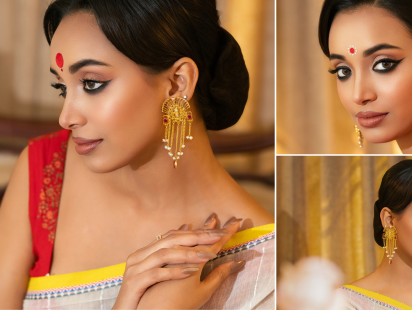


The forehead adornment known as the teep holds a unique cultural significance in Bengal, distinct from its broader South Asian religious context. It serves not only as a religious symbol but also as an aesthetic and cultural emblem in Bengali society.
In many Bengali households, wearing the teep was a common practice, akin to routine activities like combing hair or wearing bangles. It was a customary gesture for various occasions – a mother visiting someone, a teacher preparing for school, a bride’s aunt getting ready for a wedding, or a university student dressing up for Pahela Baishakh – where reaching for a bindi was almost instinctive.
For many women across generations, like 48-year-old schoolteacher Runa Mehedi, the teep is an integral part of their daily attire. It is not just an accessory but a vital element that completes the facial appearance.
The teep, often the final touch before stepping out, is also the first thing that catches people’s attention. In Bengali culture, the bindi holds multiple meanings beyond mere adornment – it signifies style, tradition, memories, and increasingly, self-expression. Today, it transcends the traditional image of a woman in a white-and-red sari on festive occasions and seamlessly complements various modern outfits like office wear, handloom attire, or casual jeans and tops.
Younger wearers, like 22-year-old university student Mrittika Saha from Dhaka, embrace the teep not for traditional reasons but as a natural extension of their identity. This shift in perception highlights the bindi’s evolution from a cultural symbol to a fashion statement.
The teep’s integration into contemporary urban fashion is a notable transformation, no longer confined to traditional attire but confidently paired with modern ensembles like denim jackets, tank tops, and sneakers. This change signifies a reinterpretation of the bindi beyond its traditional associations.
The diverse ways in which individuals wear the teep reflect a blending of modern and traditional styles, showcasing a fusion of identities. It has become a versatile accessory that can evoke ritual, style, emotion, or confidence depending on its shape, size, and color. Its enduring significance in Bengali culture lies in its ability to adapt without losing its cultural relevance, bridging the gap between tradition and fashion.
In Bengali culture, the teep serves as a subtle yet powerful means of self-expression, conveying one’s origins, identity, and chosen image to the world.