
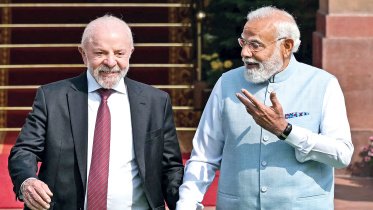


India and Brazil have agreed to enhance collaboration on vital minerals and rare earths, as announced by Prime Minister Narendra Modi following discussions with Brazilian President Luiz Inacio Lula da Silva in New Delhi. Modi emphasized that the accord on critical minerals and rare earths marks a significant step towards establishing robust supply chains.
Brazil possesses the world’s second-largest reservoirs of critical minerals, essential components utilized in various products such as electric vehicles, solar panels, smartphones, jet engines, and guided missiles. India, aiming to reduce reliance on major exporter China, has been bolstering local production and recycling efforts while exploring new suppliers.
Lula highlighted the pivotal role of the newly inked agreement in boosting investments and collaboration in renewable energies and critical minerals. Although specific details of the deal were not immediately disclosed, nine additional agreements and memoranda of understanding were finalized, spanning digital cooperation, health initiatives, entrepreneurship, and other sectors.
Asserting Brazil’s status as India’s primary trade partner in Latin America, Modi expressed the commitment to elevate bilateral trade beyond $20 billion over the next five years, underscoring the trade volume as a testament to mutual trust. Lula, in New Delhi for an artificial intelligence summit, led a delegation comprising over a dozen ministers and business leaders.
With China dominating rare earths production, several nations are seeking alternative sources. Rishabh Jain from the Council on Energy, Environment, and Water in Delhi noted that India’s deepening cooperation with Brazil concerning critical minerals aligns with recent supply chain partnerships with the United States, France, and the European Union.
India, boasting the world’s second-largest population, ranks as the tenth largest market for Brazilian exports, with bilateral trade exceeding $15 billion in 2025. Noteworthy Brazilian exports to India encompass sugar, crude oil, vegetable oils, cotton, and iron ore, with the latter witnessing heightened demand due to India’s rapid infrastructure expansion and industrial development, positioning the nation on track to be the globe’s fourth-largest economy.
Foreign Minister Subrahmanyam Jaishankar expressed confidence that the discussions between Lula and Modi would inject fresh impetus into bilateral relations. Modi highlighted the escalating cooperation in the defense sector, emphasizing a mutually beneficial partnership.