
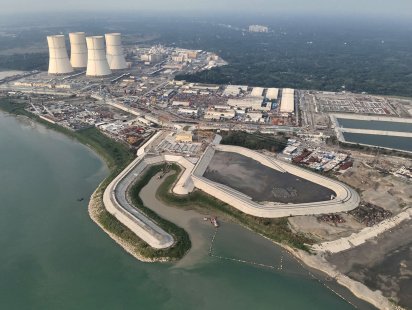


As the Rooppur nuclear power plant in Bangladesh approaches completion, policymakers are deliberating on the deployment of Small Modular Reactors (SMRs) or the addition of two more large reactors to the country’s energy mix. While the ambition is clear, there is a call for caution given the timing of these decisions.
The two VVER-1200 units at Rooppur are set to be operational by 2028, with Unit 1 expected to start generating electricity in the coming months and Unit 2 to follow next year. As Bangladesh looks towards the future of nuclear power beyond Rooppur, a crucial question arises: should SMRs be deployed or should additional large reactors be added at Rooppur as Units 3 and 4, or at new locations altogether?
The Power System Master Plan 2016 of Bangladesh outlined a vision for nuclear capacity expansion beyond Rooppur, with preliminary site surveys conducted between 2017 and 2021 along the southern coastal belt. With electricity demand projected to soar to 61 gigawatts by 2041 and an installed capacity of nearly 30,000 MW struggling to meet peak summer demands, the urgency for expansion is evident. The focus now shifts to determining the most effective approach and sequence for expanding nuclear power in the country.
Small Modular Reactors (SMRs) are nuclear reactors with an electrical output of up to 300 MW, a fraction of the output of Rooppur’s units. These innovative reactors offer several advantages, including reduced construction time due to factory fabrication, enhanced safety features that lower the risk of core meltdown, and less frequent refueling requirements. SMRs can also cater to various needs beyond electricity generation, such as providing high-temperature process heat for green hydrogen production and seawater desalination, crucial for Bangladesh’s industrial growth.
While some operational SMRs exist globally, such as Russia’s KLT-40S and China’s HTR-PM, many designs are still under construction or in the developmental phase. The potential benefits of SMRs for Bangladesh lie in gradually replacing aging fossil fuel plants, reducing import dependence, and extending reliable power to remote areas not currently connected to the national grid.
However, several constraints suggest that an immediate commitment to SMRs may be premature. Operational experience, regulatory framework development, technological maturity, and vendor selection complexities all pose challenges that need to be addressed before considering the deployment of SMRs in Bangladesh.
A proposed three-stage roadmap outlines a strategic approach to integrating SMRs into Bangladesh’s energy portfolio. The initial stages focus on fully commissioning Rooppur units 1 and 2, gaining operational experience, enhancing regulatory capabilities, and investing in nuclear workforce development. Subsequent stages involve the addition of two more large reactors at Rooppur to address the energy deficit efficiently, leveraging existing infrastructure and operational synergies.
The final stage introduces SMRs into the energy mix once mature technology, robust supply chains, and a competent regulatory system are established. Feasibility studies, technology assessments, and workforce development initiatives for SMRs should commence early to ensure readiness when conditions permit their deployment.
In conclusion, Bangladesh’s energy security necessitates a transition towards reliable clean energy sources, with nuclear power playing a crucial role in this transformation. By strategically sequencing the deployment of nuclear technologies, Bangladesh can pave the way for sustainable energy development and enhance its energy security in the long run.