
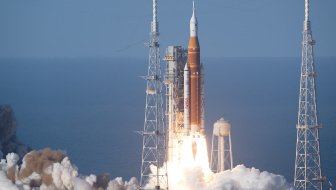


NASA has successfully initiated the Artemis II mission, marking the first human journey beyond low Earth orbit since Apollo 17 in 1972. This mission, described by NASA administrator Jared Isaacman as a significant milestone in lunar exploration, aims to bring humanity back to the Moon after over half a century. The last human lunar landing was achieved by Apollo 17 in December 1972, and Artemis II signifies the end of a 50-year gap in crewed Moon missions. The 10-day test flight will see four astronauts circumnavigate the Moon, although a landing is not planned. This mission serves as a crucial step towards reinstating human presence on the Moon, reminiscent of the historic Apollo missions.
Artemis II primarily serves as a technology test flight, with objectives including demonstrating life support systems with crew for the first time and laying the groundwork for sustained lunar presence in preparation for future Mars missions. The mission will evaluate the performance of the Orion spacecraft’s life-support, propulsion, power, and navigation systems in actual space conditions. Throughout the flight, four astronauts will operate the capsule in Earth orbit, practice rendezvous procedures, and embark on a journey approximately 46,000 miles past Earth before looping around the Moon.
Data collected during the mission will guide future phases of the Artemis program, which involve docking maneuvers with lunar landers and ultimately culminating in a human landing near the Moon’s south pole, scheduled for Artemis III in 2027 and Artemis IV in 2028. NASA’s strategic timeline is influenced by geopolitical factors, with the agency acknowledging competition from major geopolitical rivals, particularly China, as a driving force behind the urgency of the program.
China’s recent accomplishments in lunar exploration, including uncrewed landings and plans to send Chinese astronauts to the Moon by the end of the decade, have intensified the race for lunar dominance. For NASA, reestablishing a presence on the Moon is not just about scientific exploration but also about maintaining leadership in space endeavors. Moreover, the Moon’s scientific significance persists, as recent research has revealed the presence of water and other volatile compounds on its surface, contrary to previous assumptions.
NASA’s past missions and studies have already indicated traces of water on the Moon, with recent observations revealing ice deposits in shaded craters. These resources are crucial for sustaining future missions, as water can be utilized for drinking and converted into oxygen and hydrogen for life support systems and fuel. Additionally, the Moon serves as a geological time capsule, preserving a history of solar system impacts over billions of years due to its lack of atmospheric and tectonic processes, offering valuable insights into the early stages of the solar system’s formation.