
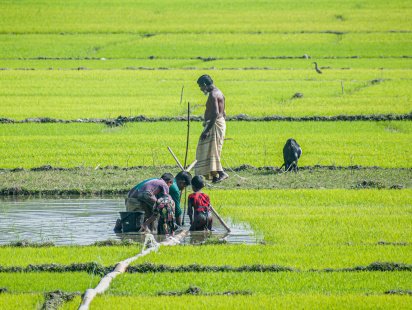


Bangladesh has experienced a significant population surge in the last 25 years, adding nearly five crore individuals. This population growth has put immense strain on the country’s primary food source, rice. Despite an increase in rice production, the rate of growth has not kept pace with the population rise, leading to concerns about long-term food security and sustainability.
The population of Bangladesh has increased from approximately 12.9 crore in 2000 to around 17.6 crore in 2025, marking a rise of over one-third. During the same period, national rice production has grown from about 3.6 crore tonnes to 3.7-3.9 crore tonnes, indicating only a modest overall growth. Experts suggest that the slowdown in yield growth over the past decade is due to land constraints, climate challenges, and limited resources. As the demand for rice continues to escalate with population growth, even minor fluctuations in production can impact prices and necessitate imports.
The existing pressure on food production in Bangladesh is now exacerbated by an ongoing energy crisis. The critical Boro paddy season has been disrupted by severe diesel shortages, escalating fuel costs, and power outages, rendering traditional farming methods vulnerable. Thousands of irrigation pumps have been inactive, and state-operated fertilizer plants have been forced to shut down. This immediate crisis underscores the urgent need to transition to sustainable agricultural practices as a necessity rather than an environmental goal for the future. To meet the challenge of producing more rice with fewer resources, embracing modern and resilient farming techniques is crucial.
The core dilemma facing Bangladesh is further complicated by the interplay between rice production and the environment, creating a hazardous feedback loop. Traditional rice farming practices contribute to environmental harm in various ways.
Methane emissions: Conventional rice cultivation involves keeping fields flooded for extended periods, leading to the production of methane, a potent greenhouse gas. Globally, rice cultivation accounts for approximately 10-12% of agricultural greenhouse gas emissions, with Bangladesh making a significant contribution.
Groundwater depletion: The cultivation of dry-season Boro rice heavily relies on groundwater, particularly through the extensive use of tube wells. This practice has led to a significant decline in water levels, contributing to carbon emissions and leaving farmers susceptible to fuel shortages.
Fertilizer pollution and nitrous oxide: Excessive use of chemical fertilizers, especially urea, results in the release of nitrous oxide, another potent greenhouse gas. Moreover, nutrient runoff from over-application pollutes water bodies, affecting water quality and aquatic ecosystems.
Ecosystem degradation: The expansion of agricultural land leads to biodiversity loss and the destruction of essential wetlands, which play a crucial role in natural carbon sequestration, flood prevention, and supporting local fisheries.
Meanwhile, the impacts of climate change are increasingly jeopardizing rice farming, with rising temperatures, erratic rainfall, and salinity intrusion affecting crop yields. Studies indicate that temperature increases during the growing season can significantly reduce yields, particularly for Boro rice, while sea-level rise poses a threat to soil fertility due to saltwater intrusion.
To address the dual challenge of increasing rice production to meet growing demands without compromising the environment, Bangladesh must adopt a strategy of sustainable intensification. This approach involves enhancing productivity on existing farmland while actively reducing environmental stress. Agricultural experts recommend several key strategies to achieve this goal.
Climate-resilient varieties: Utilizing rice strains resistant to floods, salinity, and drought can help stabilize yields in vulnerable regions, reducing the risk of crop losses.
Smart irrigation: Techniques like alternate wetting and drying (AWD) reduce water consumption and methane emissions by not continuously submerging fields. Combining this with solar-powered pumps and improved field leveling can help farmers cut energy costs and mitigate grid failures.
Precision nutrient management: Modern practices such as site-specific nutrient management and integrated soil fertility management enhance fertilizer efficiency, reducing waste and nitrous oxide emissions.
Integrated Pest Management (IPM): By utilizing biological controls and monitoring pests before resorting to chemical sprays, farmers can reduce pesticide use without compromising productivity, safeguarding biodiversity and human health.
Minimizing post-harvest losses: Upgrading to modern milling facilities and adopting hermetic storage technologies can significantly reduce post-harvest losses, boosting food availability without the need for increased production.
Mechanization: Embracing modern equipment like rice transplanters and combine harvesters can enhance efficiency, address labor shortages, and support resource-efficient practices such as direct-seeded rice.
Strategic expansion: While the focus should primarily be on intensifying yields on existing farmland, Bangladesh can also explore new agricultural opportunities in emerging river char lands and coastal regions. However, this expansion must be accompanied by the use of climate-resilient varieties and community-based irrigation.
While Bangladesh has made notable strides in increasing rice production, the environmental and energy costs of traditional farming practices cannot be overlooked. Moving forward, the focus must shift towards smarter production methods, combining scientific innovation, efficient resource management, and robust agricultural policies to achieve sustainable growth.