
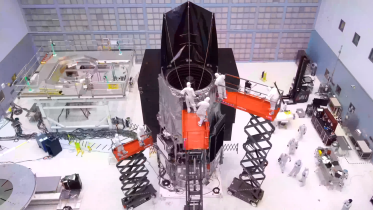


NASA’s Nancy Grace Roman Space Telescope is set to be launched in September 2026, nearly eight months earlier than its original target of May 2027. The observatory has achieved a crucial milestone and has been given the green light for the next phase of construction. The primary spacecraft systems have been finalized, and the integration process is ready to commence at the Goddard Space Flight Center, as confirmed by NASA.
Named after NASA’s inaugural chief astronomer, renowned as the “mother of the Hubble Space Telescope,” Roman is a cutting-edge observatory engineered to peer through cosmic dust and vast expanses of space and time to survey the infrared cosmos. With a field of view at least 100 times broader than that of Hubble, it is poised to capture light from a billion galaxies during its operational lifespan. The telescope is designed not only to block out starlight for direct imaging of exoplanets and planet-forming disks but also to conduct a comprehensive survey of planetary systems, as well as explore dark energy and infrared astrophysics.
The primary mirror of Roman spans 7.9 feet in diameter, identical to that of Hubble but with significantly reduced weight at 410 pounds, thanks to technological advancements. Positioned at the second Sun-Earth Lagrange point, around 930,000 miles away from Earth, the telescope will benefit from stable orbits with minimal intervention due to gravitational forces.
Equipped with two main science instruments, the observatory features the Wide Field Instrument, a 300-megapixel infrared camera intended for studying the early universe and charting its expansion history. Additionally, the Coronagraph will showcase technology aimed at suppressing starlight to directly capture images of planets nearly a billion times fainter than their parent stars.
NASA asserts that Roman will delve into fundamental astrophysical inquiries, leveraging its expansive field of view to capture light from a billion galaxies over its lifespan, facilitating research on dark energy and tracking the universe’s expansion over time.
Furthermore, the telescope will scrutinize the standard cosmological model, which outlines the universe’s characteristics but has displayed some inconsistencies in recent times. Roman’s capabilities will be instrumental in assessing the accuracy of the model and guiding researchers towards a more profound comprehension of the universe.
Moreover, the observatory will conduct a comprehensive survey of planetary systems within the galaxy and directly image exoplanets by mitigating the glare from their host stars.
According to an official statement from NASA, the telescope has undergone rigorous environmental assessments, including simulations of acoustic blasts, vibration tests, and trials in thermal vacuum chambers simulating the harsh temperatures of space.