
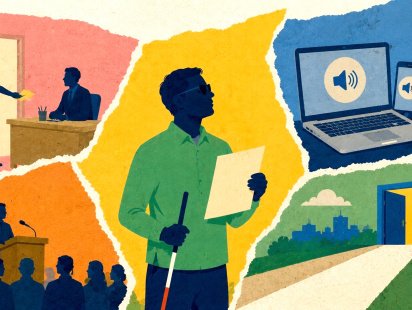


Years ago, during my university days, I visited a government office with an invitation letter in hand. At that time, I was serving as the president of the Rotaract Club of Islamabad, Chattogram, which is connected to Rotary International. My purpose was to invite a senior government official to be the chief guest at one of our club’s events. However, upon my arrival, an office assistant asked me to wait outside. After a brief wait, he returned and discreetly offered me money, explaining that the official would not be available to meet me that day.
I was momentarily taken aback. Holding a white cane due to my visual impairment, I was mistaken for someone in need of charity. The concept that I could be there as the elected leader of a youth organization had not even crossed his mind. Politely declining the money, I proceeded to meet the official directly. After introducing myself and explaining the purpose of my visit, I handed him the invitation letter. Subsequently, he attended the event and expressed sincere apologies, admitting that he had not envisioned a visually impaired person leading an organization with over a hundred members.
The incident from over a decade ago still resonates with me vividly, not because of the money offered, but because it highlighted a broader issue beyond one individual’s misconception. It shed light on a prevailing mindset in our society where disabilities are often prioritized over the individual. We tend to focus on limitations rather than recognizing potential and too quickly assume dependence instead of acknowledging leadership, talent, or expertise.
In my professional journey advocating for disability inclusion and digital accessibility in Bangladesh, I have frequently encountered this mindset. Many still hold the belief that individuals with disabilities are incapable of effectively utilizing technology, handling demanding roles, or assuming leadership positions. Yet, the reality paints a different picture.
Today, advancements in technology have expanded possibilities significantly. Individuals with visual impairments can leverage screen readers to navigate computers and smartphones, send emails, access government services, pursue higher education, engage in research activities, and collaborate with organizations worldwide. This firsthand experience shapes my perspective daily.
The challenge lies not in the disabilities themselves but in our systems, services, and attitudes that often overlook inclusivity. An inaccessible website may inadvertently exclude a qualified job seeker, an unfriendly mobile application can hinder access to financial services, and a poorly designed government portal might deny citizens critical information and services. In many instances, it is societal constructs rather than impairments that create barriers.
This realization often proves eye-opening for professionals participating in the Disability and Digital Inclusion Training (DDT), an initiative of Aspire to Innovate (a2i) that I have contributed to designing and leading. The training unites government officials, educators, tech experts, development practitioners, UN entities, and corporate representatives to delve into disability inclusion and digital accessibility. Over 1,500 professionals, including 400+ government officials, have engaged in the program.
One poignant moment during these sessions leaves a lasting impact. Witnessing a screen reader user swiftly navigate a computer, browse websites, respond to emails, analyze data, and perform intricate digital tasks independently often leaves participants speechless. Many later confess to being unaware of such capabilities, a sentiment ingrained by societal norms associating disabilities with limitations. Challenging these assumptions marks the onset of genuine inclusion.
Bangladesh is swiftly progressing towards a digital future where government services, education, healthcare, banking, and job opportunities are migrating online. This transition holds immense promise. However, without embedding accessibility into this digital evolution, millions risk exclusion. Digital transformation devoid of inclusivity breeds digital inequity. The silver lining is that accessibility benefits everyone. Clearer information, user-friendly websites, and services tailored for diverse users foster a more inclusive and efficient society.
Persons with disabilities seek not sympathy but equal opportunities. They do not crave charity but demand accessible systems, inclusive policies, and a society that upholds their rights and capabilities.
The young man who stepped into that government office years ago sought not aid but extended an invitation. Today, thousands of individuals with disabilities across Bangladesh extend a similar invitation to society—a call to transcend stereotypes, to replace sympathy with respect, and to appreciate ability over disability.
The question remains: Are we prepared to accept this invitation? Disability does not inhibit individuals; instead, it is inaccessible environments, exclusionary systems, and ingrained assumptions that restrict potential. To foster an inclusive future, Bangladesh must shift focus from limitations to possibilities within the community, marking the true inception of inclusion.