
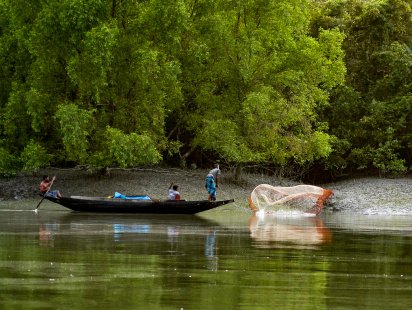


Bangladesh’s economic growth strategy heavily relies on bolstering trade, enhancing competitive exports, strengthening infrastructure, and fostering productive employment. Surprisingly, one crucial element often overlooked in economic policy dialogues is the Sundarbans mangrove ecosystems.
The Sundarbans, recognized as the world’s largest continuous mangrove forest and a UNESCO World Heritage Site, holds immense ecological significance and serves as a key economic asset. However, its resilience is facing mounting challenges. A recent study published in Communications Earth & Environment revealed that approximately 10-15 percent of the Sundarbans (equivalent to 610 to 990 square kilometers) has shown a decline in its ability to recover from climate stress over a 25-year period. This raises concerns about the long-term viability of the ecosystem services vital to Bangladesh’s coastal economy.
The mangrove forest plays a crucial role in safeguarding coastal infrastructure and commercial activities from cyclones and storm surges, supporting fisheries essential for food security and export revenue, generating around $53 million annually through tourism, and sustaining the livelihoods of millions of coastal residents. In fact, for many low-income households, mangrove resources contribute to nearly 75 percent of their annual income. Recognizing mangroves as a productive natural asset, rather than solely a conservation resource, is imperative for Bangladesh’s economic resilience, competitiveness, and sustainable growth.
While the direct income from fisheries, honey production, timber, and tourism is evident, the true value of mangroves lies in the economic losses they prevent. By mitigating storm surges, reducing coastal erosion, and acting as a shield against cyclones, the Sundarbans plays a crucial role in protecting ports, embankments, transport routes, agricultural lands, and coastal businesses that form the backbone of Bangladesh’s economy. Studies indicate that healthy mangrove belts can slash storm damage by half, thereby reducing disaster-related losses, alleviating pressure on public finances, enhancing business continuity, and bolstering investor confidence.
However, the substantial economic benefits provided by mangroves often go unnoticed in GDP calculations and national accounts, leading development decisions to underestimate the true costs of ecosystem degradation while overestimating the gains from alternative land uses. To make sound economic choices, it is vital to incorporate natural capital value alongside conventional growth metrics in accounting systems.
Recognizing this gap, many countries have started integrating natural capital into development planning through the United Nations’ System of Environmental-Economic Accounting (SEEA). These additional accounts quantify the economic contributions of forests, wetlands, and mangroves, enabling governments to make more informed decisions on infrastructure, land use, and public investments. Consequently, the Bangladesh Bureau of Statistics (BBS) is working on developing the country’s inaugural Natural Resource Accounts (NRA), a significant stride towards aligning environmental assets with economic decision-making.
By systematically assessing the economic value of natural assets like the Sundarbans and linking them to economic activities, these accounts can furnish a robust evidence base for climate-resilient fiscal planning and sustainable land-use choices. As this initiative expands, the economic worth of ecosystem services and the costs of environmental degradation can be more accurately reflected in economic policymaking, fostering a more resilient, productive, and sustainable long-term growth trajectory.
Moreover, mangroves present a promising avenue within the emerging blue-carbon economy for Bangladesh. Unlike terrestrial forests, mangroves store vast amounts of carbon, offering opportunities to produce verified blue carbon credits tradable in international markets. Revenues from these markets could fund ecosystem restoration, enhance coastal resilience, support local livelihoods, and attract private investments through public-private partnerships.
Bangladesh is currently not only underinvesting in its ecosystems but also depleting valuable natural capital due to weak governance and unregulated coastal development. Recent mangrove destruction in Sonadia and continuous degradation in Moheshkhali highlight the steep economic toll of treating mangroves as expendable land rather than productive assets. Rampant activities like shrimp farming, salt production, land encroachment, and haphazard development have led to the clearance of extensive mangrove areas, weakening the coastline’s natural defenses against cyclones and erosion, diminishing ecotourism prospects, and undermining coastal livelihoods. This ecological deterioration is exacerbating salinity levels across the delta, reducing agricultural output, exacerbating freshwater scarcity, and intensifying the unpaid burden of water collection, especially for women, thus dampening labor productivity in coastal regions.
Once mangroves are converted for short-term commercial benefits, Bangladesh forfeits enduring economic advantages, including disaster risk reduction, fisheries productivity, tourism revenue, biodiversity preservation, and future blue carbon income, while incurring significantly higher adaptation and reconstruction costs.
As Bangladesh progresses towards upper-middle-income status, the quality of its growth hinges not only on expanding physical infrastructure but also on safeguarding crucial natural assets that buttress economic endeavors. Acknowledging mangroves as strategic economic infrastructure and incorporating their value into national development planning, infrastructure assessments, and public investments through natural capital accounting should be