
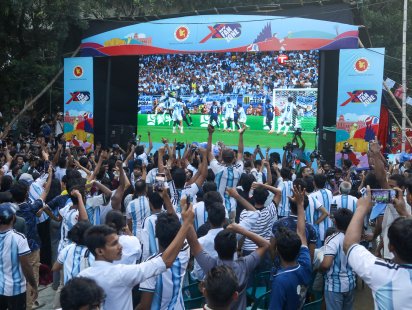


The FIFA World Cup 2026 commenced in June, sparking intense competition that led to violent clashes in Bangladesh. In Habiganj’s Kashipur village on June 3, a friendly match between Argentina and Brazil supporters turned aggressive, resulting in numerous injuries. Despite Bangladesh’s slim chances of winning the World Cup, the country experiences a fervent divide during the tournament. Streets and neighborhoods are adorned with either Argentina’s blue and white stripes or Brazil’s green and yellow colors, turning close acquaintances into sudden rivals.
The love for football in Bangladesh has deep roots, coinciding with the introduction of satellite television in households. Fans have grown up admiring legendary players from Brazil and Argentina, with allegiance to these teams becoming a core part of their identity. The FIFA World Cup has evolved into a month-long festivity, with TVs, mobile devices, and public screens serving as gathering spots for friends and families to cheer on their favored teams.
However, this passion sometimes escalates into violence. The incident in Kashipur is not an anomaly but part of a recurring pattern during past World Cups. In the 2022 tournament, five fatalities occurred due to clashes among rival supporters, with 35 hospitalizations and 45 injuries reported. Another alarming event involved 300 individuals engaging in a clash that left at least seven injured.
The aggressive conduct of fans and the rapid escalation of sports rivalries can be associated with the Bedouin syndrome, a social concept revolving around four principles of social alliances. When applied in the context of charged sports rivalries, it can serve as a catalyst for mass violence. This recurring violence during the FIFA World Cup is viewed by criminology experts as a reflection of group identity and collective aggression, where a minor disagreement between rival fans can spiral into a community-wide confrontation.
Despite the predictable nature of such incidents during the FIFA World Cup, the response from authorities has been reactive rather than proactive. To address this issue, police should conduct risk assessments of areas with a history of violence, engage in community policing involving youth groups and leaders, organize supervised public screenings of high-tension matches, promote sportsmanship through awareness campaigns, and closely monitor social media for provocative content during major tournaments.
As the FIFA World Cup progresses, with emotionally charged matches on the horizon, thousands of youths will gather to watch the games with fervent loyalties. The challenge lies in ensuring that this passion for football remains a joyous celebration rather than a trigger for violence.