
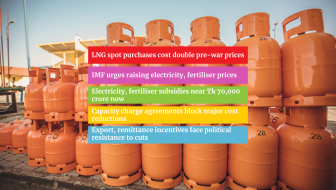


The gas subsidy has tripled this fiscal year, alongside subsidies for electricity and fertiliser, due to costly purchases from the international spot market related to the Iran conflict.
In the revised budget, the gas sector’s allocation has surged from Tk 6,000 crore to nearly Tk 19,000 crore. By May, Tk 13,000 crore was disbursed to the energy ministry, as per finance ministry officials with direct knowledge.
Between March and June, 38 cargoes will be procured from the spot market at an average price of $20 per one million British thermal units (MMBtu), compared to $9–11 per MMBtu pre-conflict, as per a finance ministry internal report.
For the upcoming fiscal year, LNG subsidies are pegged at Tk 6,500 crore with hopes of price declines if the war concludes swiftly.
Subsidies, incentives, and loans in the revised budget for this fiscal year totaled Tk 128,956 crore, up from Tk 125,904 crore in the original budget, but scaled back to Tk 127,563 crore in the next fiscal year.
Various factors such as high inflation, surging global fuel prices, war-induced commodity cost spikes, and capacity charges have led to increased subsidies in electricity, fertiliser, and food sectors.
In the coming fiscal year, Tk 64,000 crore is earmarked for electricity and fertiliser subsidies, with Tk 37,000 crore allocated for electricity. Previously, in fiscal 2020-21, these subsidies were around Tk 16,000 crore but have now escalated to nearly Tk 70,000 crore.
The International Monetary Fund has long advised the government to raise electricity and fertiliser prices to address these subsidy hikes.
Addressing capacity payments in the power sector, Energy Minister Iqbal Hassan Mahmood Tuku highlighted the challenges posed by contractual obligations with private power producers and the potential consequences of disrupting these agreements.
To alleviate the impact of soaring inflation, food subsidies have been substantially increased with Tk 10,215 crore allocated in the revised budget for the current fiscal year.
Incentives for remittance and other sectors have also seen a rise, while export incentives have been slightly reduced from the previous year.
The government plans to sustain subsidies and incentives in jute products and other sectors in the upcoming fiscal year.
Former World Bank economist Zahid Hussain emphasized the difficulty in reducing fertiliser subsidies politically and the limited scope for subsidy cuts due to increased international market prices.
He underscored the challenges in addressing electricity subsidies, suggesting the need for reforms in contractual agreements to achieve cost reductions effectively.
Hussain also discussed the gradual phasing out of export sector incentives as Bangladesh transitions away from least-developed country status, emphasizing the importance of strategic economic decisions amidst changing market dynamics.