
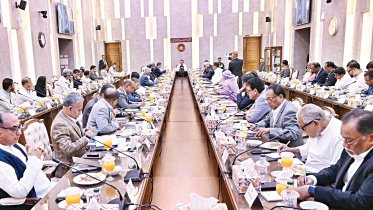


The recently appointed finance minister, Amir Khosru Mahmud Chowdhury, is faced with the immediate challenge of addressing inflation, despite arriving with a set agenda including fiscal reform and negotiations with international lenders. The public’s perception of the new government’s effectiveness is likely to be influenced by the price of food, particularly as Ramadan begins, typically leading to increased demand and higher prices for essential goods.
Recent data reveals a concerning trend, with inflation climbing to 8.58 percent year-on-year in January, contrary to expectations of a slowdown. Of particular worry is the acceleration of food inflation from 7.71 percent in December to 8.29 percent in January. The finance minister must navigate this familiar yet critical political landscape, where public trust in the government’s economic management hinges significantly on food prices.
Economist Selim Raihan emphasizes the importance of sending a clear message against unjustified price hikes to businesses, supported by a comprehensive evaluation of supply conditions. Effective coordination among various ministries such as finance, commerce, and home affairs is deemed crucial for a coherent response, an aspect where previous administrations have struggled. Raihan warns that the political “honeymoon” period may be short-lived, with public patience wearing thin within six months.
The new government, under the leadership of Prime Minister Tarique Rahman, inherits an economically fragile state heavily reliant on external support. Bangladesh entered an IMF program in January 2023 due to a sharp decline in foreign exchange reserves, leading to periodic tensions in the relationship. Previous hopes of international leniency during negotiations were dashed, as loan disbursements were halted for non-compliance and resumed only after stringent adherence to requirements.
An upcoming IMF mission is expected in Dhaka, focusing on fiscal discipline, monetary tightening, and reform progress. Securing ongoing support is crucial not just for IMF financing but also for instilling confidence among other international lenders. The finance minister faces the challenge of balancing the IMF’s emphasis on contractionary monetary policy to curb inflation with the need for economic growth.
While stabilizing reserves provides some relief, the current apparent stability is partly due to economic slowdown. Business investment has declined, imports have moderated, and credit growth in the banking sector is at historic lows. The government’s success in reviving growth could lead to increased demand for foreign currency, potentially straining reserves as seen in the past.
The fiscal landscape is equally demanding, with proposed civil service salary increases posing a significant budgetary burden. With preparations for the FY2027 budget underway, revenue mobilization becomes paramount. Effective revenue generation is essential as Bangladesh has struggled to achieve a revenue surplus for almost two decades, heavily relying on borrowing for development programs.
Public debt levels have surged by around 60 percent in just over three years, reaching Tk 21.5 trillion by September 2025. The government’s reliance on bank financing has increased substantially, absorbing liquidity and potentially limiting credit available for private businesses.
To ensure sustainable public finances without hindering growth, the government must enhance revenue collection from an undertaxed economy. Addressing issues such as VAT collection leakage through improved tax administration and modernization can lead to significant gains without raising tax rates. Structural reforms, including granting autonomy to the central bank and reforming the National Board of Revenue, are crucial but slow to materialize.
The banking sector, requiring significant overhaul, faces challenges in restoring confidence to encourage business investment and economic growth. Graduation from the Least Developed Country category in November poses both progress and potential trade preference losses for Bangladesh. Debate continues on seeking an extension, with a decision required soon to navigate the impending changes effectively.
In conclusion, the new government confronts a web of complex challenges ranging from stabilizing food prices to managing public debt and implementing tax reforms. Success will hinge on cohesive policies, coordination across sectors, credibility, and unwavering political determination. Navigating these challenges successfully will not only secure the government’s position but also establish a foundation for a stable and effective term. Failure to address these pressing issues could swiftly erode the initial goodwill of the administration, highlighting the formidable task of governing in economically turbulent times.