
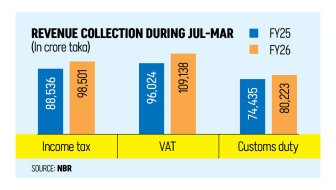


The National Board of Revenue (NBR) has fallen short of its nine-month tax collection goal by nearly Tk 1 lakh crore, necessitating the mobilization of over Tk 2.60 lakh crore in the final quarter of the fiscal year 2025-26 (FY26). Provisional data released recently revealed that collections amounted to Tk 2.87 lakh crore from July to March, marking an 11 percent increase compared to the previous year but falling significantly below the full-year target of Tk 5.54 lakh crore. Analysts are skeptical about the board’s ability to achieve almost half of the annual target within the remaining three months.
The NBR has a history of consistently missing its annual targets for over a decade. Despite a positive start to the fiscal year with strong first-quarter collections leading to an upward revision of the target in late November last year, the revenue shortfall persists amid challenging economic conditions. Bangladesh’s GDP growth has slowed, defaulted loans in the banking sector have surged, and the tax-to-GDP ratio has declined significantly, signaling a struggling business environment.
External factors, such as the impact of the US-Israel war on Iran, have further strained the government’s finances as high energy prices have led to increased import costs. The country heavily relies on energy imports, and the escalating expenses have put pressure on the state coffers. The government is seeking budget support from development partners and implementing structural reforms to address the economic challenges.
Due to persistent revenue shortfalls, the government has resorted to increased borrowing, with net deficit financing rising substantially. Experts warn that the fiscal space has narrowed, limiting resources for development spending. Without significant reforms in revenue administration, achieving substantial revenue growth seems unlikely. Weak imports are expected to dampen revenue in the final quarter, potentially impacting credit flow to the private sector.
To address the revenue challenges, the NBR is considering structural changes for the upcoming fiscal year 2026-27 (FY27). Plans include strengthening enforcement to combat tax evasion, reducing tax exemptions, and introducing new measures such as a wealth tax, inheritance tax, and higher tax rates for the ultra-rich. These initiatives aim to enhance revenue collections and improve the fiscal outlook for the future.