


Rabindranath Tagore, renowned as Asia’s inaugural Nobel laureate, left an indelible mark not only through his literary achievements but also through his pioneering impact on fashion. The Tagore family from Jorasanko didn’t just shape the Bengali Renaissance; they redefined it. By blending European functionality, Mughal sophistication, and local craftsmanship, Tagore and his associates established a unique Bengali modernity in attire that continues to influence contemporary fashion trends. As noted in Shesher Kobita by Tagore himself, “Fashion is a mask, and style is the visage behind” — a philosophy that elevated clothing from mere attire to a reflection of cultural identity.
Creating a Distinct “Bengali Style”
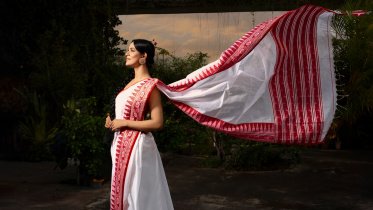
Prior to the Tagores, traditional Bengali women’s clothing was predominantly unstitched and confined to domestic settings. The transition began with Jnanadanandini Devi, Rabindranath Tagore’s sister-in-law, who introduced a new way of draping the saree influenced by her time in Bombay. She incorporated aspects of the Parsi/Gujarati saree draping style along with modern blouses and petticoats, popularizing it as the “Brahmika saree” through publications like Bamabodhini Patrika, later evolving into the “Bombay Dastur” and eventually the “Thakurbarir saree.”
This sartorial evolution was not just a matter of aesthetics but had deep-rooted political implications. Renowned researcher Sangeeta Datta highlighted, “Jnanadanandini pioneered the modern saree draping style with trendy shirt blouses, marking a time when women were transitioning from secluded spaces to the public eye.” This new draping technique facilitated mobility, dignity, and active participation in the Brahmo Samaj reform movement. The Tagores, through their innovative approach to clothing, embedded social liberation into every stitch, empowering homemakers to venture beyond the confines of their homes while upholding their grace and dignity.
For men, Rabindranath Tagore himself set a distinctive style standard. His ankle-length jubba or kaftan, paired with a long beard and soft chappals, defined the visual identity of the Bengali intellectual, distinct from both the British formal suit and the traditional dhoti. He embodied a forward-thinking persona, creating a recognizable image that encapsulated simplicity, spirituality, and defiance within a single garment.
Cultivating a Selective Modernity, Steering Clear of Mimicry
The Tagores embraced a cosmopolitan outlook without succumbing to colonial influences. Residing in Jorasanko during the Crown Raj of 1858, they amalgamated “Western ideas” with discernible Persian elements, resulting in a curated fusion. European elements like chemises, petticoats, blouse-jackets, shoes, and brooches found their way into Tagore’s circle.
Even Suniti Devi, the daughter of Keshab Sen, donned a Spanish mantilla-inspired headscarf. However, these imported elements were tailored to suit the Bengali climate and cultural modesty. The blouses were never revealing, and the petticoats eschewed voluminous crinolines. The women of the Tagore household embodied a harmonious blend of diverse cultural influences, fostering a unique and enduring identity within their attire.
Tagore’s meticulous approach to costume design for stage productions and his detailed descriptions in novels and dance-dramas underscored his keen eye for fashion. Contemporary designers still draw inspiration from his works to comprehend the fusion of British fashion with traditional Bengali aesthetics during his era.
Infusing Nationalism into Textiles
Tagore’s second revolution unfolded at Santiniketan. Following his travels to Java and Bali in 1927, he introduced Javanese batik, a wax-resist dyeing technique, to Kala Bhavana. The art of batik, integrated into the curriculum at Visva-Bharati, blossomed into a cottage industry providing livelihoods to thousands, seamlessly blending with local customs and traditions.
This initiative served as Tagore’s response to Gandhi’s advocacy for khadi. While both luminaries championed handloom textiles, Tagore’s approach to nationalism was more aesthetic than ascetic. His students were not only encouraged to wear handloom fabrics but also to learn the art of spinning and weaving. This initiative dovetailed with the development of rural industries and traditional crafts like leatherwork, specialized batik, and kantha. Tagore promoted indigenous weaves while rejecting the notion of sartorial uniformity, presenting a distinctive perspective on nationalism as opposed to Gandhi’s ideology. Consequently, fabrics like garad, tant, baluchari, and batik emerged as symbols of refined Bengali taste.
The Timeless Appeal of Bengali Fashion
Tagore’s enduring influence stems from its foundation in timeless principles rather than fleeting trends. Three