
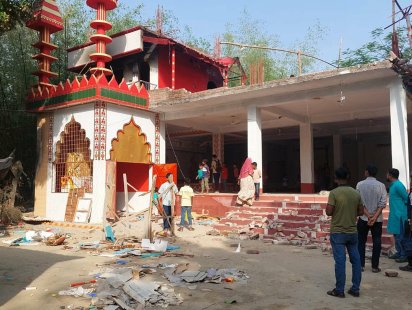


Amid a disturbing trend of recurrent incidents, the nation witnessed a tragic event last Saturday in Kushtia where a Sufi pir, Shamim al-Jahangir, was lynched within his shrine. The shrine was vandalized and set ablaze following allegations from an old video circulating on social media, accused of containing disrespectful remarks about religious sentiments. The victim was found in critical condition, rescued by the police, and rushed to a hospital, but unfortunately succumbed to his injuries upon arrival.
Such incidents have unfortunately become all too common in Bangladesh. Just a day prior to the Kushtia tragedy, a group known as “Azadi Andolon” assaulted and harassed several individuals, including women, in the Shahbagh area of the capital, labeling them as homosexual. The recurring pattern reveals a concerning trend where attacks, sometimes fatal, are launched against individuals merely for differing ideologies, beliefs, or opinions.
These instances highlight the swift execution of collective violence and the alarming trend of perpetrators escaping consequences. Shockingly, a significant portion of the population not only justifies such acts but, in some cases, openly celebrates them. These occurrences rarely exist in isolation and, given the current atmosphere, it is unrealistic to assume they will cease.
According to the Human Rights Support Society (HRSS), the first three months of 2026 witnessed 49 deaths in mob violence and lynching incidents across Bangladesh, spanning 88 separate events. Triggers for these occurrences varied from theft accusations to personal disputes and, increasingly, allegations of religious disrespect disseminated through online platforms.
Attacks on shrines have become distressingly frequent over recent times. A study by Maqam: Center for Sufi Heritage revealed 97 shrine attacks between August 2024 and December 2025, resulting in three fatalities and 468 injuries. Despite the scale of violence, only 11 cases were reported, with minimal progress in investigations. Political activists were allegedly involved in many of these attacks, using tactics like mobilizing crowds with bulldozers and loudspeakers to destroy shrine structures.
Beyond shrines, assaults on Baul practitioners, cultural events, and artistic spaces have been recurrent. These targeted victims represent a longstanding tradition of pluralism in Bengal’s religious and cultural landscape, where faith, music, and local customs have traditionally coexisted. The vulnerability of these spaces today stems from not just ideological animosity but a growing societal tolerance for such actions.
The normalization of violence is perpetuated through various channels, including media language choices. In the Kushtia incident, some media outlets questioned the legitimacy of the victim’s spiritual title, adding unnecessary ambiguity to the narrative. This diversionary tactic detracts from the core issue of accountability within religious institutions when violence is propagated in the name of faith.
The ongoing attacks on shrines under the current government unveil a deeper crisis. Previous explanations attributing such violence to weak governance no longer suffice, as the pattern persists irrespective of the ruling authority. The erosion of societal values and the rise of extremist elements have roots that transcend political regimes.
Addressing this crisis requires a critical examination of institutional responses that have been reactive and ineffective. Law enforcement’s delayed interventions and sluggish legal processes contribute to a perception of impunity among perpetrators. The inadequacy of formal justice mechanisms fuels demands for extrajudicial actions, undermining the rule of law.
The government’s response to these challenges has fallen short of expectations, raising concerns about its ability to curb mob violence and protect vulnerable communities. Recognizing and rectifying these shortcomings is crucial to restoring public trust in the state’s capacity to maintain law and order.