
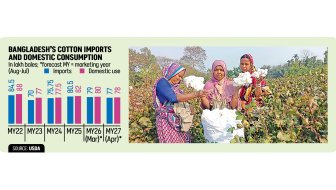


The USDA has once again decreased its cotton import forecast for Bangladesh in the current marketing year 2025-26, attributing the decline to reduced utilization in mills. The new projection indicates that Bangladesh is expected to import 77 lakh bales this year, a 2.5 percent drop from the initial estimate of 79 lakh bales made in March. This marks the third downward adjustment since January when the forecast stood at 80 lakh bales.
According to Md Mohiuddin Rubel, a former director of the Bangladesh Garment Manufacturers and Exporters Association, the USDA revised the import forecast on April 6 due to various factors including energy shortages, decreased garment export orders, higher yarn imports, and challenges related to finance and logistics, resulting in a more significant reduction in spinning activity than anticipated.
The downward revision aligns with a 5.5 percent year-on-year decline in Bangladesh’s readymade garment exports during July-March of the current marketing year. Knitwear, the primary consumer of cotton yarn, experienced a 6.4 percent decrease in the same period.
Rubel highlighted that the garment sector continues to face pressures stemming from macroeconomic challenges, an energy crisis, subdued global apparel demand, and pricing pressures from international buyers that erode profit margins. Additionally, operational constraints such as low gas pressure in key industrial zones have led many mills to operate below capacity, importing cotton only for confirmed orders. Concerns regarding potential loss of trade preferences upon graduating from the least developed country status have further contributed to a cautious approach.
The USDA, in its recent reports on cotton, did not mention the decline in exports but forecasted a mill usage of 78 lakh bales, down 2.5 percent from the March estimate. Global cotton consumption is projected to increase by approximately 600,000 bales to 11.91 crore bales, driven by growing demand in China and India.
The USDA anticipates a 3 percent rise in world cotton trade for the marketing year 2025-26 compared to the previous year, primarily fueled by significant increases in cotton imports by India and China. The agency noted that lower imports for Bangladesh, Pakistan, and Vietnam were offset by higher imports for China and India, as outlined in its monthly report released last week.
In its latest cotton and wool outlook released on April 13, the USDA highlighted that global cotton imports in 2025-26 are dominated by Vietnam and Bangladesh, jointly accounting for 35 percent of the total. China is expected to witness a more than 15 percent increase in cotton imports to 60 lakh bales, supporting its textile and apparel exports, while India’s cotton imports are projected to surge by 38 percent to 42 lakh bales in the current marketing year due to consecutive below-average crops necessitating higher imports.