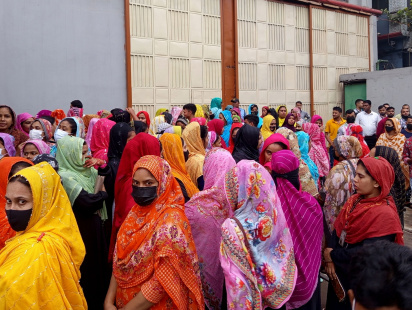
The discussion surrounding wages in the ready-made garment (RMG) sector is gaining momentum as protests and factory shutdowns escalate, especially with the deadline of December 1 for the implementation of a new wage structure looming. Various stakeholders, including workers, employers, analysts, and columnists, have proposed differing wage figures, often addressing various issues. The challenge posed by the Bangladesh Garment Manufacturers and Exporters Association (BGMEA) to the wage proposal from the Centre for Policy Dialogue (CPD) has shifted the focus from conflicting figures to the methodologies used to derive them. This shift is beneficial, as long as the objections are scrutinized as meticulously as the estimates they dispute. The minimum wage board must clarify what each figure signifies, assess the credibility of its basis, and determine how the evidence should influence its decisions.
In recent discussions with friends who manage large, compliant RMG factories, these tensions became more pronounced. They expressed understanding for the workers’ requests for a reasonable minimum wage but deemed a figure between Tk 18,000 and Tk 20,000 to be more feasible. They also advocated for a prompt decision and cautioned that delaying beyond December 1 could exacerbate unrest. Therefore, it is crucial for the wage board to analyze how affordability issues differ across factories.
The recent demand for improved data and discipline, along with the Bangladesh Bureau of Statistics’ (BBS) upcoming wage survey, represents a positive development. However, establishing wages based on concrete evidence requires careful evaluation of both the current proposals and the official data being prepared. The speed of the process or an official designation does not guarantee the quality of the outcomes.
During the board’s third meeting on Monday, employers are expected to submit their wage proposal. While workers’ representatives are advocating for Tk 32,000 for Grade 4, it is anticipated that employers might initially suggest around Tk 15,000, leaving room for negotiations and requests for government assistance. Regardless of the outcome, the wage board must critically examine the assumptions that underpin any eventual offer.
Different figures answer different questions
The CPD estimates that a wage of Tk 16,351 is necessary to restore the purchasing power of Tk 12,500. It calculates Tk 18,578 as the minimum required to keep a four-member family above the upper poverty threshold, and Tk 24,204 to be a living wage, based on the assumption of 1.58 earners per family. It suggests negotiations within the range of Tk 18,578 to Tk 24,204.
These figures serve different purposes. Restoring purchasing power does not necessarily indicate that the original wage was sufficient. Surpassing a poverty line does not ensure a decent standard of living. Likewise, a living wage calculation relies on assumptions regarding family size, the number of earners, necessary consumption, and local pricing.
BGMEA challenges CPD’s assumptions regarding household size and number of earners, its application of urban living costs from Dhaka, potential double counting of housing costs (which CPD disputes), and its approach to annual increments. It also questions industry affordability. These concerns merit responses but do not inherently prove that CPD’s estimates are incorrect. The foundational calculations should be made available for examination.
Contributions from CPD and others provide valuable reference points for a collaborative, evidence-based discussion on issues impacting workers’ livelihoods and the sustainability of employers. The wage board should apply similar scrutiny to the affordability claims made by employers. This makes the upcoming BBS survey particularly significant: independently gathered, representative data could offer a shared factual framework against which conflicting claims can be evaluated. The credibility of this data will hinge on sound methodology, safeguards against bias, and transparent analysis.
The wage board must separate workers’ needs from the capacity of factories to pay. The former is informed by household budgets, while the latter is shaped by factory costs, profit margins, orders, buyer prices, and productivity. These two sets of evidence cannot replace each other, and no single survey will yield a singularly correct “Goldilocks” wage.
What will the BBS survey establish?
According to the published schedule, BBS will commence data collection in December, with preliminary results expected in February. Nearly 3,000 private establishments across five sectors, including RMG, will be surveyed. However, BBS should make the questionnaire and sampling methods publicly accessible prior to the fieldwork. It is important to clarify how many RMG establishments will be included, and how effectively the sample will represent various factory sizes, locations, and employment types. Will subcontracting entities be adequately included? National coverage does not guarantee precise estimates for every industrial zone or worker demographic. Published findings should reveal sample sizes, non-response rates, and uncertainties.
Definitions are equally crucial. Basic pay, total compensation, and take-home pay cannot be used interchangeably. Overtime may enhance monthly earnings while masking an insufficient wage for regular hours. Bonuses should be distinguished from regular salaries, and amounts owed should be differentiated from what is actually received. Results should illustrate the distribution of earnings across different grades and workers, rather than merely presenting an industry average.
Moreover, there is a distinction between the average factory and the average worker. Assigning the same weight to a small establishment as to one with thousands of employees would address a different question than determining typical earnings for RMG workers.
Most importantly, the pay reported by employers requires independent verification. Some experts caution that owners may inflate reported wages. When reported figures are not cross-referenced with payroll records, attendance data, and confidential worker testimonies, this limitation should be acknowledged.
Assess the household behind the worker
Some pertinent evidence predates the current wage debate. A 2016 study by the Global Living Wage Coalition employing the Anker methodology estimated family living expenses and living wages for Dhaka and its peripheral cities. Its 2025 update adjusted prior estimates for inflation and modifications in payroll deductions, rather than conducting a new household study. Existing benchmarks like these can guide wage decisions without definitively resolving them. The information gap does not arise from a lack of data but from whether these figures accurately reflect current conditions across workers, households, and factories to support the conclusions derived from them.
A wage survey cannot determine living expenses solely by documenting what factories pay. It requires supplementary household data. This makes the lack of ongoing, focused monitoring of workers’ living conditions particularly concerning for the nation’s leading export sector. Unfortunately, the BBS’s flagship Household Income and Expenditure Survey (HIES) 2022 did not include a specific module for RMG. Data from HIES-type surveys could illustrate how earnings correlate with food, housing, healthcare, education, and the number of dependents and earners.
Make the decision reviewable
Timing poses an immediate challenge. The wage board’s implementation deadline comes before the BBS’s preliminary results. The survey cannot retroactively provide the evidence needed for that decision. Additionally, waiting for these findings should not be used as a reason to delay urgently needed relief. The wage board ought to clarify which existing data it relies on now, and how the forthcoming findings will inform future reviews.
Trust is already fragile. On November 14, the BGMEA president stated that factories unable to function amid unrest might resort to “no work, no pay.” He highlighted the necessity to shield factories from vandalism. This tougher stance underscores the urgency of establishing a credible wage-setting process. Threats of lost income cannot justify an adequate wage or settle disputes over affordability. A clear timeline and transparently communicated decisions will provide a more solid foundation for trust.
Ultimately, Bangladesh requires a consistent mechanism to monitor wages, household expenses, and industry conditions in between crises. Evidence will not eliminate negotiations or disputes about fairness; however, it can render claims verifiable and decisions accountable. A significant progress would be to cease rebuilding the evidence base only after workers resort to protests.
Dr M Niaz Asadullah is a professor of economics at Dhaka University and a visiting professor at the University of Reading in the UK. He can be reached at [email protected].
Views expressed in this article are the author’s own.
Follow The Daily Star Opinion on Facebook for the latest opinions, commentaries, and analyses by experts and professionals. To contribute your article or letter to The Daily Star Opinion, see our guidelines for submission.