
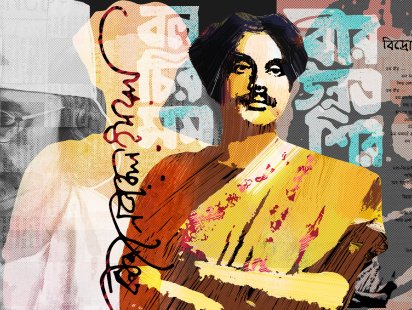


Kazi Nazrul Islam, a prominent Bangla poet known for his revolutionary stance, made a significant impact on literature with his groundbreaking poem “Bidrohi” (“The Rebel”). This poem not only marked the emergence of a new poet but also signaled the dawn of a fresh poetic consciousness deeply influenced by major global revolutions of the time.
Nazrul’s literary and political rebellion, as showcased in “Bidrohi,” was a departure from traditional norms, characterized by its daring themes, political fervor, and innovative style. His work embodied a dialectical dance of negation and affirmation, reflecting a unique blend of audacity and metrical experimentation.
Beyond being labeled as a mere “rebel poet,” Nazrul was fundamentally a revolutionary figure, inspired by historical events such as the Turkish, Irish, and Russian revolutions. His modernist approach, distinct from Eurocentric influences, embraced anti-colonialism and internationalism, setting him apart from his contemporaries.
Nazrul’s contribution to Bangla literature extended beyond poetry. He introduced new metrical forms, experimented with multiple languages, and blended elements from Hinduism and Islam in his works. His advocacy for India’s independence from British colonial rule, showcased in his magazine “Dhumketu,” underscored his commitment to social and political change.
Despite his diverse talents and nicknames reflecting his multifaceted persona, Nazrul’s relevance today lies in his advocacy for equality, human dignity, and social justice. His poetry collections like “Samyabadi” and “Sarbahara” embody his revolutionary spirit and commitment to the oppressed.
Nazrul’s work anticipated themes echoed by later activists like Frantz Fanon, emphasizing the need to decolonize the mind and resist mental slavery. He addressed communalism, racism, and environmental concerns ahead of his time, advocating for total human emancipation and societal transformation.
Although hailed as the “national poet,” Nazrul’s ideals often clash with the actions of the ruling elite in Bangladesh. His writings challenge oppressive systems and call for genuine social change, a vision that remains unrealized due to societal inertia.
Dr. Azfar Hussain, a renowned scholar, highlights Nazrul’s enduring relevance and contributions to literature and social change. His insights shed light on Nazrul’s legacy and the ongoing struggle for justice and equality in contemporary society.