
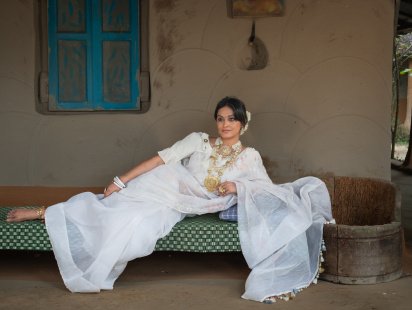


In today’s context in Bangladesh, the focus has shifted from merely preserving Jamdani and Benarasi textiles to adapting them for contemporary use. The question arises: Can these fabrics thrive beyond the traditional saree form? Is it possible for them to transition into modern silhouettes while retaining their essence and appeal on a global scale without being reduced to mere exotic attire?
Founder of Canvas, Tanwy Kabir, emphasizes that consumers today seek to effortlessly embody heritage rather than view it as a burden. This sentiment encapsulates the ongoing debate surrounding Jamdani and Benarasi textiles. While these sarees are still revered as heritage pieces and reserved for special occasions, the discourse around them has evolved beyond just preservation.
While Jamdani and Benarasi are often mentioned together, they possess distinct characteristics. Jamdani is characterized by its lightness, intricate spacing, and delicate motifs that seem to float, requiring a balance of restraint and ornamentation. On the other hand, Benarasi is denser, more ceremonial, and closely associated with bridal wear, featuring elaborate zari work and visual opulence.
The unique qualities of these textiles necessitate different design approaches for reimagining them. Jamdani can be adapted through texture, transparency, and motif placement, while Benarasi requires a careful consideration of weight, shine, and structure in redesigning them. It is crucial that any redesign efforts are thoughtful and considerate of the original craftsmanship.
A significant challenge in the current market is the misrepresentation of these textiles. Munira Emdad from Tangail Saree Kutir highlights the issue of synthetic and power-loom produced Benarasi and Jamdani sarees being passed off as authentic handwoven pieces. The lack of awareness and technical understanding among consumers further complicates the distinction between genuine handcrafted sarees and mass-produced imitations.
To address these challenges, Tanwy Kabir underscores the importance of technical considerations in design interventions. By focusing on aspects like weight distribution, silk quality, and zari placement, the goal is to enhance wearability and breathability while maintaining the authenticity and value of the textiles.
Mansi’s founder, Maria Mumu, emphasizes the significance of direct collaboration with weavers to ensure fair wages, transparency, and recognition of the artisans’ unique contributions. Preserving the individuality and expertise of the artisans is essential in the transformation of Jamdani and Benarasi textiles for contemporary fashion without erasing their cultural heritage.
In conclusion, the future of Jamdani and Benarasi lies in striking a balance between tradition and innovation. To ensure their continued relevance and accessibility, these textiles must be adapted for various forms and global platforms while upholding the integrity of craftsmanship and respecting the artisans who bring them to life. The evolution of these textiles should be guided by informed decisions that honor their legacy and cultural significance.