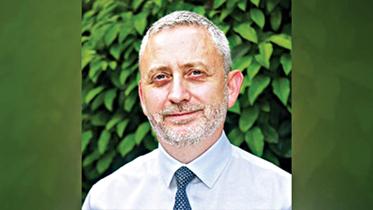
On Tuesday, Michael Miller, the European Union (EU) Ambassador and Head of Delegation to Bangladesh, stated that violence is intolerable and indicated that, as per his understanding, the authorities’ reaction to unlawful actions has been appropriate.
“In any democratic society, differing opinions can be voiced. But what are the boundaries? The boundaries encompass unlawful actions that disrupt public order and security, particularly when individuals or groups do not reject violence or even promote it,” Miller explained.
This statement came in response to inquiries regarding recent violent occurrences in the nation during an event at the National Press Club, hosted by the Diplomatic Correspondents Association, Bangladesh (DCAB), named “DCAB Talk.”
“Any entity, including the European Union, which is grounded in the rule of law and the respect for human rights, will champion the freedom of assembly and expression, yet will stand against any form of incitement to violence or hatred,” he remarked.
“Bangladesh has its challenges, but in discussions with the authorities, we emphasize that responses should remain proportionate. From my perspective, the response has been proportionate.”
Miller noted that various EU member states have faced similar challenges, emphasizing that transitions are intricate processes that cannot be accomplished instantaneously.
He mentioned the EU’s ongoing engagement with Bangladeshi authorities since the elections to bolster the country’s institutions. He also urged for increased political unity among the parties that participated in the elections to facilitate the nation’s progress.
Regarding the ready-made garment (RMG) industry, Miller expressed optimism about improvements in workers’ wage conditions and indicated that the EU supports efforts to foster broader consensus.
He characterized Bangladesh as a significant player in the EU RMG market but cautioned that its dependence on competitively priced labor would not remain advantageous indefinitely.
“Labor costs will rise. In ten years, they will be higher. It’s vital to observe how competitors are managing their primary markets,” he advised, encouraging Bangladesh to adapt to evolving market dynamics.
Discussing sustainable democracy, he affirmed that the EU will persist in supporting Bangladesh’s institutions through financial aid and political collaboration to enhance their accountability and democratic nature.
“Democracy transcends elections and parliament; it encompasses the institutions of the state,” he remarked, noting that public confidence in state institutions had dwindled during the former regime. He added that restoring that trust would necessitate a long-term commitment.
On the matter of irregular migration, Miller highlighted that Bangladesh continues to be the top country of origin for irregular migrants entering the EU. He emphasized the critical need to dismantle the criminal networks that exploit migrants.
He welcomed the move to criminalize human smuggling in Bangladesh, calling it a significant initial step in combatting irregular migration. The EU, he stated, will collaborate closely with governmental institutions on this issue.
Concerning human rights, the ambassador articulated that the respect for labor rights, environmental safeguards, and human rights is fundamental to Bangladesh-EU relations and its access to the EU market under the “Everything But Arms” initiative.
He acknowledged that while improvements are visible, the journey is ongoing, stressing that the respect for rights and the rule of law is essential to the commercial relationship.
In reference to Bangladesh’s purchase of Airbus aircraft, Miller expressed the EU’s desire for a fair playing field, allowing European companies to compete based on commercial merits. “Coercion and pressure are not appropriate business practices,” he asserted.
When asked about the media environment and security situation, Miller noted the media’s crucial role in responsibly reporting events. He expressed confidence that the government has the security situation well managed and indicated that progress should be made in the RMG sector.
He concluded by stating that the EU seeks a stable and prosperous Bangladesh, which necessitates justice, accountability for historical human rights abuses, adherence to the rule of law, a rejection of violence, and a commitment to maintaining public order and safety.