
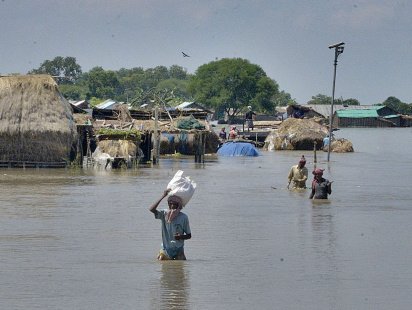


In the past, unexpected floods, heatwaves, cyclones, and droughts were seen as deviations from normal conditions. However, today, these occurrences are becoming more common, signaling a shift towards unpredictability in our environment. Our world is now facing the challenge of demanding continuous output from finite natural resources. Our societal structures have been built around the concept of stability and predictability, assuming that the future will resemble the past. But what happens when this assumption is no longer valid?
Ecological collapse presents us with not just a warmer world, but one that is increasingly erratic and uncertain. Olivier Hamant, a researcher, highlights the growing importance of variability and uncertainty in our current era. Climate change, pollution, biodiversity loss, and energy insecurity are often viewed as separate issues, but they are interconnected symptoms of a larger problem: ecological overshoot.
Our current economic system perpetuates the cycle of continuous growth, relying on increased energy, materials, and ecological capacity. However, this approach contradicts the need to address the ecological crisis caused by our excessive material demands. Anthropologist Jason Edward Hickel introduces the concept of degrowth as a way to shift from a mindset of more to one of sufficiency. He emphasizes the historical process of enclosure, where shared resources are turned into commodities, driving the need for constant economic expansion.
Enclosure can occur gradually or during times of crisis, as explored in Naomi Klein’s “The Shock Doctrine.” Disruptions like natural disasters can create opportunities for restructuring and privatization of public resources, exacerbating existing inequalities. Eco-disasters do not occur in isolation but within a framework of societal inequality and power dynamics, further complicating the response to such crises.
The conversation around climate action often focuses on technological solutions and emissions reduction, but a fundamental question remains: how much growth is sustainable? Instead of pursuing endless material expansion, we should consider defining prosperity based on living within ecological limits. It’s time to rethink our approach to wealth and well-being, shifting from a mindset of overcoming limits to one of embracing sufficiency.
As we navigate the challenges of ecological overshoot, it is crucial to reconsider our societal priorities and economic paradigms. Learning to recognize and respect the Earth’s physical limits is essential for creating a sustainable future for all. It’s no longer about how much more we can extract from the planet but rather about understanding what is truly enough for us to thrive.