
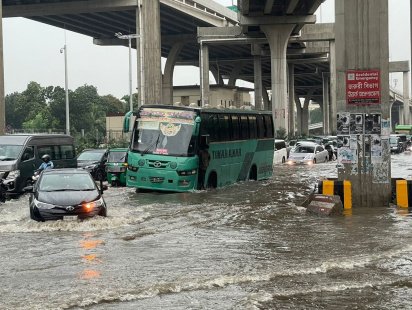


Heavy rainfall in Dhaka recently caused flooding on flyovers, creating temporary urban waterfalls that commuters had to navigate. While many find this situation frustrating, it presents an opportunity for innovative solutions to address the city’s water issues.
Dhaka struggles with waterlogging during the monsoon season and a decreasing groundwater level throughout the year. Despite heavy reliance on groundwater, aquifer levels are declining, while significant amounts of rainwater are drained out of the city annually.
One potential solution is to implement rainwater harvesting systems on elevated structures like flyovers. By directing rainwater into storage tanks or recharge wells through special drainage channels, the city could utilize the vast catchment areas of these structures to collect and return rainwater to the ground.
For instance, a 15-meter-wide, 10-kilometer-long elevated road could collect millions of liters of water during a single rainfall event. If implemented across Dhaka’s extensive network of flyovers, expressways, and metro viaducts, rainwater harvesting could yield significant water resources for the city.
Similar successful projects in countries like India and Singapore demonstrate the effectiveness of integrating rainwater harvesting into urban infrastructure. By treating rainwater as a valuable resource rather than a problem, cities can mitigate water scarcity, alleviate flooding, and promote sustainable water management practices.
In addition to replenishing aquifers and reducing stormwater runoff, stored rainwater can be used for various purposes such as landscaping, construction, and street cleaning. Embracing multi-purpose infrastructure that addresses climate risks and provides environmental and social benefits is crucial for sustainable urban development.
While concerns about water quality and contaminants exist, proven methods like sediment traps and biofiltration can ensure the cleanliness of harvested rainwater. Incorporating rainwater harvesting into existing and future infrastructure projects is not only environmentally beneficial but also economically prudent, requiring less investment compared to building new water systems.
By rethinking the role of urban structures in water management, cities like Dhaka can leverage existing infrastructure to enhance resilience to climate change and address water-related challenges efficiently. Policymakers are urged to consider rainwater collection as a fundamental aspect of urban development projects to create more sustainable and water-resilient cities.