
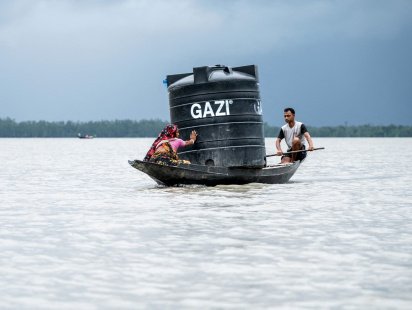


Climate change is altering Bangladesh’s landscape and affecting where people live, work, and plan for the future. By 2050, an estimated 1.99 crore individuals in Bangladesh could be internal climate migrants, marking a significant demographic shift. The crucial question is not just about the number of people expected to move but also whether the country is ready for the ongoing demographic changes.
In recent years, the discourse on climate mobility has evolved in Bangladesh and globally. International policy dialogues have expanded to encompass a broader understanding of climate mobility, recognizing that climate change impacts not only permanent migration but also temporary movements, seasonal relocations, planned resettlements, and decisions to stay in current locations. It has become evident that climate change intersects with livelihoods, job opportunities, environmental degradation, and social circumstances, influencing people’s choices to remain, relocate temporarily, or settle elsewhere.
Governments now need to consider more than just traditional demographic factors like fertility rates, mortality rates, and age distributions. They must also focus on how populations are distributed, how these patterns evolve over time, and the implications for development planning. Climate-induced mobility is no longer solely a migration issue but a demographic planning challenge that shapes urban development, infrastructure, public investments, and local governance.
Bangladesh has incorporated climate-driven mobility considerations into various national policies and plans, such as the National Adaptation Plan (2023-2050), Bangladesh Delta Plan 2100, National Urban Sector Policy, National Strategy on Internal Displacement, and the Population Policy 2025. While these policies acknowledge the importance of climate-driven mobility in national planning, a comprehensive planning framework that systematically links these discussions through a long-term population planning perspective is lacking.
The integration of climate-driven mobility into existing planning processes is essential. This entails aligning climate and demographic projections in major development planning to ensure that future investments match the evolving population dynamics. Strengthening governance practices by utilizing shared demographic evidence across climate adaptation, population planning, urban development, social protection, and local governance sectors is crucial to address this challenge effectively.
To navigate the evolving demographic landscape, Bangladesh must enhance research, data systems, and population projections to anticipate demographic shifts driven by climate change effectively. Climate-driven mobility is becoming a critical demographic variable that must be factored into long-term planning decisions.
Moving forward, the focus should be on enabling existing institutions to collaborate based on shared demographic evidence rather than creating new policies or entities. By incorporating climate and demographic information into national investment decisions, regional development strategies, and local service planning, Bangladesh can better prepare for the demographic transformation brought about by climate change.
The key challenge now lies in whether Bangladesh’s planning system can adapt swiftly enough to anticipate and respond to the changing population geography driven by climate change. Climate-driven mobility is not just a migration issue but a long-term population planning challenge that will shape how cities, services, infrastructure, and investments are planned in the future. Bangladesh’s climate governance needs to equip its planning system to address the evolving population dynamics effectively.