
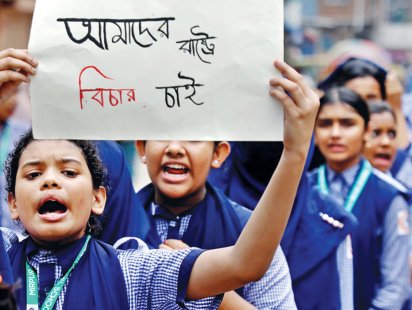


In Pallabi, Dhaka, a tragic incident unfolded on May 19 as an eight-year-old girl was subjected to rape and murder within a neighboring apartment. Her body was dismembered in an effort to hide the heinous act. The sheer brutality of the crime shook the nation, but what resonated even more deeply was the response of her father, Abdul Hannan Molla. In a poignant statement before the media, Molla expressed his lack of faith in the justice system, stating, “I do not seek justice as it has not been delivered before. There is no track record of justice being served.” He pessimistically forecasted that public outcry over his daughter’s tragedy would wane within a mere 15 days.
These sentiments no longer startle people as they once did. Families of murder victims, survivors of rape, and parents of abused children are increasingly disillusioned. Many have lost faith in the efficacy of police investigations, court proceedings, prosecution, and political leadership in ensuring their protection or holding perpetrators accountable. Some openly admit to relinquishing their pursuit of justice to a higher power due to perceived failures of the state. This erosion of trust may constitute one of the most severe institutional crises in Bangladesh.
The stark statistics paint a grim picture. In the first four months of this year, over 1,142 murder cases were reported, a surge from 1,017 in 2025 and 1,006 in 2024. The number of murders escalated from 250 in February to 317 in March before slightly tapering to 288 in April. According to the rights organization Ain o Salish Kendra, at least 115 children lost their lives during the same period, with 12 succumbing after alleged rape or attempted rape, 59 following torture, and 20 going missing.
Despite the deluge of cases, Bangladesh’s criminal justice system grapples with a colossal backlog. Over 4.5 million cases were pending as of June last year, surpassing 4.7 million later, with lower courts shouldering over 4 million cases. Trials drag on for years, witnesses vanish, and victims deplete their resources attending adjourned hearings. Conviction rates in rape and violence-related cases remain alarmingly low. Recent police data indicate conviction rates of only 2.61% in cases involving violence against women and 0.52% in children-related cases in the first eight months of last year, significantly below the overall criminal conviction rate of approximately 28%. A joint study by the Supreme Court and BRAC revealed that 15 districts reported zero convictions between January and June last year.
Consequently, while thousands of rape and murder cases are lodged annually, only a fraction result in convictions. Many accused individuals swiftly secure bail, particularly if they wield financial power or possess local influence or political connections. In contrast, victims, their families, and witnesses encounter intimidation, societal pressure, and financial ruin. Some are compelled to abandon their cases entirely due to insurmountable challenges.
The issue permeates the entire justice system. Bangladesh still lacks a comprehensive victim and witness protection law, leaving families vulnerable to retaliation. Impoverished individuals, especially daily wage earners or working-class families, cannot bear the burden of frequent court appearances, missed income, or prolonged legal uncertainty. In certain instances, local power brokers dissuade them from seeking justice. Police investigations often falter due to inadequate resources or external interference. Forensic capabilities remain limited, delays become routine, and Bangladesh ranks 125th out of 143 countries in the 2025 World Justice Project Rule of Law Index.
However, the emotional toll transcends mere numbers. For many families, the agony deepens as they realize the state may never deliver substantive responses. Endless court proceedings deplete finances, energy, and mental well-being, leading some to conclude that pursuing justice only prolongs suffering. Communities internalize this lesson too. When influential suspects evade repercussions repeatedly while ordinary victims endure prolonged struggles, people begin viewing the system as capricious rather than reliable.
In such an environment, informal mechanisms supplant formal justice. Village arbitration, political interventions, personal connections, and societal pressure fill the void left by feeble institutions. This sometimes results in discreet settlements, intimidation, or even public support for extrajudicial measures. The endorsement of “crossfire” and similar shortcuts partly stems from frustration with a judicial system perceived as sluggish, biased, and inaccessible. When faith in the judicial process wanes, harsh alternatives appear appealing. Once due process diminishes, abuse proliferates rather than diminishes.
The deeper crisis lies in the impact on the relationship between citizens and the state. A functional state hinges not only on laws but on the assurance that institutions will shield the vulnerable, penalize transgressions, and treat all citizens equitably, irrespective of status or affluence. When this assurance crumbles, skepticism takes root, leading to disengagement. Public indignation morph