
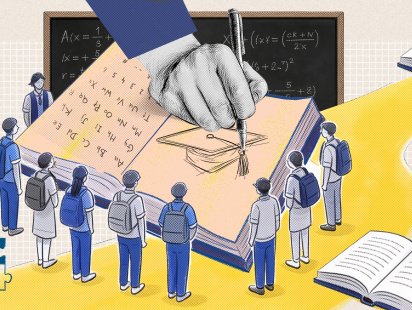


The proposed budget for the fiscal year 2026-2027 marks a significant departure from previous years by increasing the allocation for education. In the revised budget for the current year, the education sector received the lowest proportion of GDP in a decade, standing at approximately 1.4 percent. The upcoming fiscal year proposes an allocation of Tk 1,22,495 crore for the Ministry of Primary and Mass Education, Secondary and Higher Education Division, and Technical and Madrasa Education Division. When combined with allocations for other ministries like textiles, railways, defence, agriculture, fisheries, and ICT, the total education budget amounts to Tk 1,36,606 crore, which is 14.56 percent of the total budget.
This budget, the first from the BNP government in twenty years, focuses on shifting priorities towards human capital development and fostering a democratic, inclusive economy. The speech outlined plans for curriculum reform in schools, introducing a compulsory third language instruction, providing free education for female students up to undergraduate level, offering school uniforms, shoes, and bags, implementing mid-day meals, and providing specialized learning materials for children with special needs. Additionally, technical and vocational education will be introduced from Class 6, new subjects on sports and culture will be included in textbooks, and emphasis will be placed on “learning with happiness.”
The education budget will also support quality enhancement programs in science, mathematics, English, and information technology in madrasas, along with initiatives like “One Teacher, One Tab,” multimedia classrooms, and free Wi-Fi in educational institutions. However, critics raise concerns about the emphasis on rewriting the curriculum rather than implementing it effectively in classrooms. They question the practicality of compulsory additional foreign language instruction and vocational courses at the secondary level, suggesting that the focus should be on teaching basic competencies.
The education system faces challenges, as illustrated by a decline in enrollment in government primary schools over the years. While primary-level madrasas and private schools have seen increases in enrollment, government schools struggle to retain students due to various factors. The need for fundamental changes in pedagogy, teacher training, and infrastructure is essential to improve the quality of education in Bangladesh.
In conclusion, while the proposed budget signifies a shift towards investing in education and human capital, there are ongoing concerns about the effectiveness of the planned reforms and the need for a holistic approach to address the underlying issues in the education sector.