
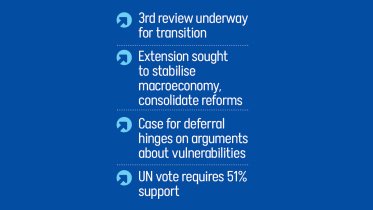


The government, on its first full day in office, has formally requested a three-year extension for Bangladesh’s graduation from the least developed country (LDC) category. Shahriar Kader Siddiky, the secretary of the Economic Relations Division, sent a letter to José Antonio Ocampo, the chair of the UN Committee for Development Policy (UN CDP), seeking to delay the graduation until November 24, 2029.
Bangladesh is currently set to graduate on November 24 this year, with ongoing reviews in preparation for the transition. The interim government, following recommendations from business leaders, trade bodies, and economists, had suggested aligning with other graduating countries like Nepal and Lao PDR to push for a deferral until 2030, leaving the final decision to the elected government.
The newly formed government argued in the letter that an extension would offer crucial policy space to stabilize the macroeconomy, implement reforms, and complete priority actions under the Smooth Transition Strategy (STS). The government highlighted that the previous preparatory period had been significantly disrupted by various external and domestic challenges, such as the lingering impacts of the Covid-19 pandemic, global economic slowdown, the Russia-Ukraine conflict affecting energy and food markets, and other geopolitical and trade uncertainties.
Domestically, issues in the financial sector, political upheavals, and unresolved matters like the Rohingya repatriation to Myanmar had put pressure on the economy, leading to macroeconomic instability, lower GDP growth, inflation, reduced investments, and other challenges. This situation had shifted the focus to short-term stabilization efforts, leaving limited room for graduation-related reforms, as intended during the preparatory period.
The government also expressed concerns over potential trade disruptions post-graduation, including issues with the EU’s GSP+ facility, US tariffs, and evolving trade agreements. The letter emphasized the importance of completing structural priorities like customs modernization, energy reforms, and export diversification, which had faced delays due to cumulative shocks and policy shifts.
Reflecting on an independent Graduation Readiness Assessment, the government highlighted concerns about the readiness for graduation in 2026 aligning with development progress, suggesting a potential extension under the Enhanced Monitoring Mechanism (EMM) crisis-response provision.
Considering the risks to macroeconomic stability, export performance, employment, and poverty reduction, the government believed that proceeding with graduation under the current timeline could jeopardize the gains made, making a case for deferral.
CPD Distinguished Fellow Mustafizur Rahman confirmed that Bangladesh meets all graduation criteria but noted that arguments for deferral would need to focus on structural vulnerabilities. Any decision on deferral would require a UN-level vote, with the support of at least 51% of member states.