
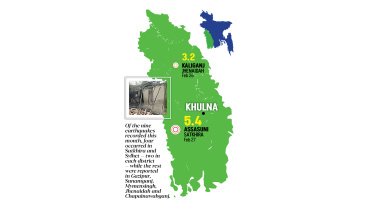


Two earthquakes hit the Khulna region in less than a day, causing concern in an area not accustomed to seismic events.
The Bangladesh Meteorological Department reported that a 5.4-magnitude earthquake struck Assasuni in Satkhira, 188km southwest of Dhaka, at 1:52pm yesterday.
The quake was felt in various districts, including the capital city and Kolkata, prompting people to evacuate buildings as structures trembled throughout the area.
A separate 3.2-magnitude tremor occurred on Thursday in Kaliganj, Jhenaidah, an adjacent district to Satkhira.
Within the past 27 days, a total of nine earthquakes have shaken Bangladesh, causing worry among experts and locals.
A resident of Kaliganj upazila in Satkhira, Nabidul Islam, described his experience during the earthquake, noting the intense shaking that led him to seek safety outside.
The recent surge in seismic activity, with four earthquakes in Satkhira and Sylhet each, and others in Gazipur, Sunamganj, Mymensingh, Chapainawabganj, and Jhenaidah, has heightened concerns among the population.
The series of earthquakes, ranging from 3.0 to 5.4 on the Richter scale, categorized as minor to moderate by the Bangladesh Meteorological Department, have occurred at an unusual frequency.
Experts, including Prof Syed Humayun Akhter and Bodruddoza Mia, have highlighted the seismic risks in Bangladesh due to its location in a tectonically active zone and the need for updated seismic data and mapping to assess earthquake vulnerabilities accurately.
Although Bangladesh lacks identified “mega-thrust” fault lines within its borders, the country remains at risk of significant earthquakes, as evidenced by historical seismic events in the region.
The geological setting of Bangladesh, situated at the convergence of multiple tectonic plates, including the Indian, Myanmar, and Eurasian plates, poses a significant seismic hazard, exacerbated by fault lines like the Dauki Fault in Sylhet and the Sagaing Fault in Myanmar.