
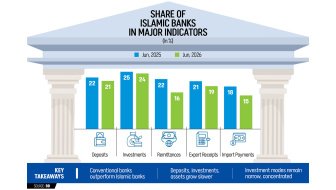


Islamic banks experienced a 27% decline in remittances channeled, totaling $448 million in June 2026, as reported by Bangladesh Bank (BB). Their share of total remittances within the banking system dropped from 22% to 16% compared to the previous year. In contrast, conventional banks saw a 7.25% increase in remittance receipts, reaching $2.37 billion in June, despite a 15% decrease from the previous month’s $2.78 billion.
The BB noted that the inability of Islamic banks to maintain their market share of remittances contributed to the growth of conventional banks in this sector. This trend highlights instability within the Islamic banking industry. Workers’ remittance receipts are crucial for building foreign currency reserves and facilitating foreign currency transactions. The BB recommended that Islamic banks address factors affecting depositor confidence to stay competitive.
The decrease in remittances in June could be attributed to the exceptionally high inflow recorded in May before Eid-ul-Azha. Geopolitical tensions in the Middle East, particularly the Iran crisis, may have also impacted remittance patterns.
Regarding deposits and investments, Islamic banks saw an increase in deposits in June compared to the previous year, but conventional banks experienced higher growth. Islamic banks’ share of total banking deposits decreased to 21% in June 2026 from over 22% a year earlier. Depositors are gradually shifting towards Islamic banking due to increased confidence, supported by central bank measures to enhance liquidity support and management capacity.
In terms of investments, conventional banks dominated with three-fourths of total investments, while Islamic banks held the remaining share. Conventional banks recorded a 12% year-on-year increase in investments to Tk 19.25 lakh crore, while shariah-based banks saw a 7% growth to Tk 6.12 lakh crore in June 2026. The BB attributed this growth to rising demand for Islamic financing products.
Conventional banks exercised caution in lending and investment amid macroeconomic challenges in Bangladesh. Islamic banks’ share in export receipts handling decreased to 19% in June 2026, while conventional banks took a larger share of over 81%. In terms of import payments, Islamic banks accounted for 15%, with conventional banks handling the remaining 85% in June 2026.