
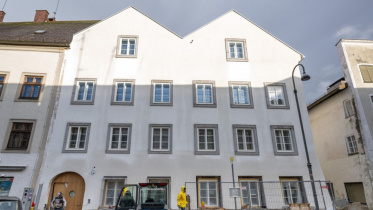


In the Austrian town of Braunau am Inn, the decision to convert the house where Adolf Hitler was born into a police station has evoked a mixture of sentiments among residents. Sibylle Treiblmaier, a 53-year-old office assistant, described the move as having both positive and negative implications, stating that while it may deter far-right extremists from congregating at the site, she believes there could have been alternative uses for the building.
In 2016, the government passed a law to assume control of the deteriorating property from its private owner with the intention of “neutralizing” the historical significance of the site. Austria, which was annexed by Hitler’s Germany in 1938, has faced criticism in the past for not fully acknowledging its role in the Holocaust.
The far-right Freedom Party, originally founded by former Nazis, has gained popularity in recent years, although it has not succeeded in forming a government. Efforts to address Austria’s Nazi past have included renaming streets in Braunau am Inn that previously commemorated Nazis, following persistent advocacy by activists.
The house where Hitler was born in 1889 is located in the town center, adorned with a memorial stone advocating for peace and democracy. Renovation work on the facade was observed during a recent visit by AFP, with plans for police officers to occupy the building by the second quarter of 2026.
Author Ludwig Laher, a member of the Mauthausen Committee Austria, expressed concerns about the decision to house a police station at the site, suggesting that it may present challenges given the political obligations of law enforcement. Previous proposals to transform the building into a space for dialogue on peace-building received significant support, according to Laher.
Local resident Jasmin Stadler suggested that providing historical context about Hitler’s birthplace within the house could have been an intriguing alternative. Criticism was also directed at the considerable cost of the renovation, estimated at 20 million euros ($24 million).
While some residents support the conversion of the house into a police station, viewing it as a means to prevent the site from becoming a focal point for far-right extremists, others have reservations. Wolfgang Leithner, a 57-year-old electrical engineer, expressed hope that the transformation would bring a sense of tranquility to the area.
Debates surrounding Austria’s Holocaust history persist, reflecting on the atrocities committed during Nazi rule, which resulted in the deaths of 65,000 Austrian Jews and the forced exile of 130,000 individuals.