
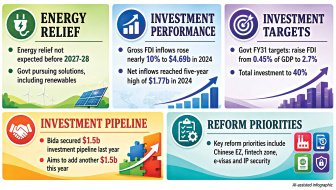


Energy shortages, particularly the lack of natural gas, continue to pose a significant challenge for both local and foreign investors in Bangladesh, as stated by Ashik Chowdhury, the executive chairman of Bangladesh Investment Development Authority (Bida). Chowdhury highlighted that foreign and domestic investors alike encounter similar obstacles, with the primary concern revolving around energy issues, specifically the scarcity of gas. He addressed these concerns during a workshop held at Bida’s office, emphasizing how gas shortages have severely impacted factories and how investors also grapple with electricity supply challenges and regulatory complexities at the National Board of Revenue (NBR).
Chowdhury emphasized that Bida dedicates a considerable amount of time to energy-related initiatives due to the critical role energy constraints play as a major hindrance to investment and economic progress. Despite organizing various investment summits, attracting investors proves futile if they face operational difficulties in running their factories. The government is actively seeking solutions, such as implementing renewable energy projects and enhancing gas supply infrastructure. However, Chowdhury acknowledged that resolving the energy crisis will be a time-consuming process.
He mentioned that the installation of a new floating storage and regasification unit (FSRU) alone would take a minimum of 18 months from the commencement of work. Projects currently underway are anticipated to alleviate the energy shortage by 2027-28. Chowdhury also pointed out the existing structural limitations within the gas infrastructure, emphasizing that even if private investors establish gas-fired power plants in economic zones, fuel supply would still rely on the government’s ability to import and distribute gas effectively.
The energy challenge forms a crucial part of the broader investment agenda outlined by the government in the proposed budget for FY2026-27. The government aims to boost foreign direct investment from the current 0.45 percent of GDP to 2.7 percent by FY31 and elevate total investment to 40 percent within the next five years as part of its medium-term strategy. Meanwhile, Nahian Rahman Rochi, an executive member of Bida, highlighted the agency’s comprehensive approach to the investment lifecycle, encompassing promotion, policy support, approvals, service delivery, and aftercare.
Rochi outlined Bida’s one-year work plan, consisting of 25 initiatives categorized under infrastructure development, investment facilitation, and investment development pillars. Notable priorities include industrial park development, advancements in the Chinese Economic Zone, intellectual property reforms, establishment of overseas BIDA offices, and industry mapping. Rochi mentioned that Bida secured a $1.5 billion investment pipeline last year and aims to add another $1.5 billion this year, totaling around $3 billion over two years.
Furthermore, Nurjahan Akter, an additional director at the Bangladesh Bank, highlighted that Bangladesh reports FDI on a net basis, potentially understating actual inflows. She explained that FDI comprises equity capital, reinvested earnings, and inter-company loans, with the latter aiding foreign-owned firms in managing liquidity pressures through support from parent companies. In 2024, gross FDI inflows surged nearly 10 percent year-on-year to $4.69 billion, with net inflows reaching a five-year peak at $1.77 billion, as per the BB official.
Md Humayun Kabir, the secretary at Bida, mentioned the government’s ongoing efforts to enhance the investment climate through reforms, including streamlining visa processes, work permits, and business registrations via the Bangladesh One Stop Service platform. He expressed optimism that the new investment incentive policy and continued reforms will drive increased investment, including contributions from non-resident Bangladeshis.