
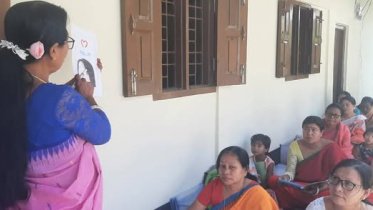


In a small village called Haktiarkhola, every Friday morning sees a unique classroom setting on a serene veranda. Children gather on plastic mats, attentively watching retired schoolteacher and poet Brinda Rani Sinha as she meticulously writes the intricate Manipuri script, known as Meitei Mayek, on a blackboard. The youngsters echo her teachings, absorbing the language’s alphabet, vocabulary, and sentence structure, a skill that many of their parents lack despite being able to speak Manipuri.
The Manipuri community in Kamalganj upazila of Moulvibazar has a long tradition of conversing in their native tongue during various occasions. However, the literacy in this language has been steadily declining over the years, with the script fading from everyday use. To combat this trend, Brinda established the Manipuri Language Training Centre, also referred to as the Meetai Moyek Tambibagi School, in 2019 on the balcony of her home in Adampur union.
Driven by the fear of the language vanishing, Brinda took the initiative to ensure its survival and growth by providing a platform for learning. The classes, held every Friday from 10:00 am to 11:30 am, attract around 25 to 30 children, with occasional gatherings of homemakers on selected afternoons. Despite challenges posed by the Covid-19 pandemic, the classes persisted with reduced attendance and necessary safety measures.
Having retired as an assistant teacher in July 2023, Brinda garnered support from the community and her family before launching the project. With limited resources initially, she received assistance in the form of books, a blackboard, and financial contributions for equipment. Additionally, Lakshmikanta Singh from the Ethnic Community Development Organization provided educational materials for the center.
The Manipuri language, also known as Mitilon, holds significant cultural value for the community settled in the Kamalganj area. Despite speaking Manipuri at home, the increasing usage of Bangla in external settings has led to a gradual neglect of their mother tongue. Although there are provisions for ethnic minority students to learn in their native language at the primary level, the lack of proper implementation hinders language preservation efforts.
The Manipuri script, Meitei Mayek, carries a rich heritage and is integral to the community’s identity. Since its establishment, the Manipuri Language Training Centre has empowered over 100 students from Hindu Manipuri and Muslim Manipuri backgrounds to read and write in their mother tongue. Some students have even pursued higher education in esteemed institutions.
Participants like Bimala Sinha express gratitude for the classes, emphasizing the positive impact on their language skills. Brinda’s dedication to teaching, especially to homemakers, has been instrumental in revitalizing interest in Manipuri literacy within the community. Despite her literary accomplishments, she views the veranda classroom as her most fulfilling endeavor, committed to its continuation as long as she is physically able.
The centre has been applauded by Sajjadul Haque, president of the Panghal Research and Publication Organisation, for providing a crucial space for Meitei and Panghal students to nurture their language proficiency. In the absence of formal avenues for language practice at the state level, the centre stands as a beacon for preserving the Manipuri script and cultural identity.
Amidst the simplicity of a village balcony adorned with chalk dust and plastic mats, a silent yet profound effort persists — not for accolades or incentives, but to safeguard a script and the essence it embodies.