
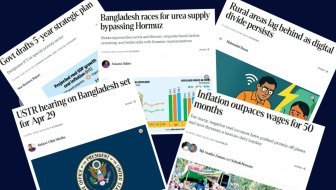


Last week in Bangladesh, the economy was heavily influenced by looming international trade investigations, a persistent cost-of-living crisis, and the urgent need to secure agricultural inputs. Additionally, the country faced challenges related to long-term strategic growth planning and a widening technological gap between urban and rural populations.
The United States Trade Representative (USTR) announced a scheduled hearing on April 29 to investigate alleged overcapacity and forced labor in Bangladesh under Section 301. The probe aims to assess if trade policies negatively impact US manufacturing and reshoring efforts.
Inflation in Bangladesh has surpassed wage growth for 50 consecutive months until March, resulting in a decline in real incomes over the past four years. The Bangladesh Bureau of Statistics (BBS) reported that the March wage growth of 8.09 percent lagged behind the 8.71 percent inflation rate by 0.62 percentage points.
Bangladesh faced an urgent need for urea imports after a recent tender failed to attract bidders ahead of the June Aman planting season. This urgency arose due to the closure of five urea factories following gas supply concerns related to the US-Israel conflict with Iran and the subsequent shutdown of the Strait of Hormuz, a critical route for global fertilizer trade.
The government unveiled a five-year strategic plan aimed at achieving a trillion-dollar economy by 2034. The plan prioritizes the ICT sector, targets sending 20 lakh workers abroad annually, and forecasts real GDP growth to reach 8 percent.
A recent survey by the BBS highlighted a significant digital divide between rural (43.6 percent) and urban (75.7 percent) populations in internet usage, with a gap of 32.1 percentage points. High costs of equipment and subscriptions continue to hinder access to the internet, leaving almost half of the country offline despite widespread mobile penetration.