
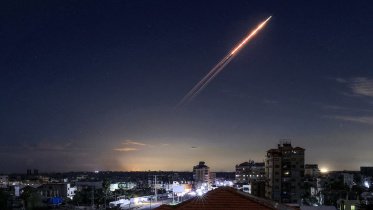


The United States targeted numerous locations throughout Iran, while Israel expanded its airstrikes to Lebanon on Monday following President Donald Trump’s pledge to retaliate for the first American casualties in the conflict aimed at ousting Iran’s ruling clerics.
Iranian forces launched missiles and drones across the Middle East, resulting in casualties in Israel and the United Arab Emirates in response to the hostilities initiated on Saturday with the passing of Iran’s supreme leader, Ayatollah Ali Khamenei.
On Sunday, the US military broadened its range of targets in Iran, announcing the destruction of the headquarters of the Islamic Revolutionary Guard Corps (IRGC), the specialized unit responsible for upholding the theocratic regime established in 1979.
According to a statement from US Central Command, the IRGC’s headquarters has been eliminated. Meanwhile, the Israeli military conducted significant airstrikes in central Tehran on Monday and carried out bombings in Lebanon targeting Hezbollah, the Shiite Muslim militant group closely aligned with Iran.
Explosions were reported in Beirut by an AFP journalist. Hezbollah, previously weakened by Israeli actions, retaliated by launching rockets and drones towards Israel, citing vengeance for Khamenei’s death.
President Trump and Israeli Prime Minister Benjamin Netanyahu have advocated for the overthrow of the Iranian government, a longstanding adversary of both Israel and the US since the 1979 Islamic revolution that deposed the pro-Western shah.
In an interview with the New York Times, Trump indicated that the US and Israel were prepared to sustain the current rate of attacks for four to five weeks, stating that ammunition stockpiles were substantial. He also mentioned having a shortlist of three unnamed individuals he preferred to lead Iran post-war.
In a video message, Trump warned Iranian security forces to surrender their arms and receive immunity or face imminent death, emphasizing the dire consequences of non-compliance.
The Pentagon reported the loss of three US service members in the operation, with five others sustaining severe injuries in the campaign dubbed “Epic Fury.” Trump acknowledged the likelihood of further casualties but reaffirmed America’s commitment to avenging the fallen soldiers and dealing a severe blow to the terrorist entities combating civilization.
Despite his previous anti-intervention stance, Trump has not extensively elaborated on the rationale for the military action to the American populace. Hakeem Jeffries, the leading Democrat in the House of Representatives, criticized the soldiers’ deaths as a reckless outcome of an unjustified preemptive military initiative.
Iran’s surviving leadership has remained defiant, justifying retaliatory measures as acts of self-defense. In Israel, a missile attack from Iran resulted in casualties in Beit Shemesh, prompting President Masoud Pezeshkian to label Khamenei’s demise as an act of war against Muslims, vowing retribution.
Ali Larijani, the influential head of Iran’s Supreme National Security Council, issued a stern warning of unprecedented force against the aggressors. The military actions by Israel and the US followed a period where Iran quashed widespread protests, posing a significant challenge to the regime.
Trump encouraged Iranians to rise against their government, pledging American support. Reza Pahlavi, son of the former shah, advised vigilance amidst airstrikes and advocated for opposition to the Islamic republic.
While some Iranians celebrated Khamenei’s reported death, pro-government demonstrations emerged following official confirmation, echoing anti-American sentiments. Iran appointed Ayatollah Alireza Arafi to join Pezeshkian in an interim leadership council during the search for a permanent successor to the supreme leader.
Despite widespread support within the Iranian diaspora for Khamenei’s demise, Pakistan witnessed protests and casualties in response to the military actions. International leaders displayed mixed reactions to the conflict that unfolded shortly after discussions between Iran and the US on Tehran’s nuclear program.
British Prime Minister Keir Starmer permitted the US to utilize UK bases for defensive operations but refrained from engaging in offensive activities. Iran’s initial retaliatory strikes impacted all Gulf states except Oman, with subsequent incidents targeting Oman’s commercial port of Duqm and maritime traffic in the Strait of Hormuz.
The Revolutionary Guards claimed to have struck the USS Abraham Lincoln aircraft carrier, a claim refuted by the Pentagon. Trump asserted that US military strikes had incapacitated Iranian naval vessels and inflicted damage on their navy headquarters.
Iran’s retaliatory actions in the Gulf resulted in casualties, while the Red Crescent reported significant civilian losses within the country. Iranian authorities confirmed the deaths of key figures, including Ali Shamkhani and General Mohammad Pakpour, in the ongoing conflict.