
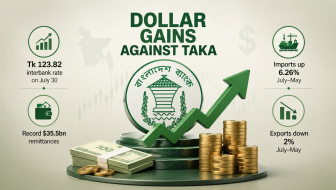


The US dollar is strengthening against the Bangladeshi taka due to rising demand for foreign currency to settle import-related expenses. On July 13, the weighted average rate of the dollar reached Tk 123 in interbank transactions, marking an incremental rise following a period of stability. Subsequently, on July 30, the taka-dollar exchange rate climbed to Tk 123.82 in the interbank market, with the spot market pricing the dollar at Tk 123.88 on the same day as per Bangladesh Bank (BB) records.
A senior official from a private bank highlighted the mounting pressure for import payments, particularly for essential commodities like fuel and fertilizers procured by government entities. The overall import activity has surged during this period. The data from BB revealed a 6.26 percent year-on-year growth in imports amounting to $64 billion from July to May. Conversely, exports experienced a 2 percent decline year-on-year, totaling $40 billion, according to BB statistics.
Banking experts noted a record $35.5 billion in remittances received from overseas Bangladeshi workers; however, recent remittance inflows have decelerated post the Eid-ul-Fitr and Eid-ul-Azha celebrations. Another banker expressed concerns over the subdued export outlook, attributing it to the heightened conflicts in the Middle East leading to a spike in oil prices. Such factors are anticipated to exert sustained pressure on the taka in the near term.
Nonetheless, a weaker taka is expected to bolster the competitiveness of exports, providing a silver lining amidst the challenging economic climate. With the surge in foreign currency demand, BB ceased purchasing US dollars from the market since June 8. The central bank had procured $6.4 billion from the market between July 2025 and June 2026 to fortify foreign exchange reserves.