
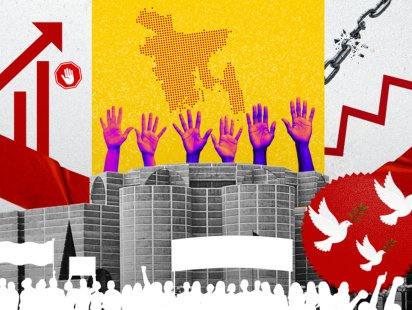


In Bangladeshi politics, a crucial yet often overlooked issue pertains to the sources of funding and the benefits derived from such financial support. While discussions on political finance typically revolve around legal spending limits and declared campaign expenses, the fundamental concern remains unaddressed: money has become a key determinant of political involvement.
Under current regulations, parliamentary candidates are restricted to spending up to Tk 10 per voter, with a maximum cap of Tk 25 lakh based on the constituency’s voter count. However, the 2026 election shed light on the disparity between these limits and the actual costs involved. Despite all 1,981 candidates collectively declaring campaign expenses just below Tk 400 crore, independent analysis revealed that the true expenditure from obtaining a nomination to running a competitive campaign far exceeded the legal ceiling. A study by Transparency International Bangladesh (TIB) in 2024 estimated that average candidate spending during elections is approximately six times higher than the prescribed limit.
While national elections occur every five years, political parties operate continuously, requiring a steady influx of funds to sustain their activities, maintain offices, compensate activists, and cover ongoing costs. However, the sources of financing for these operations lack transparency and accountability.
The discussion on reforming political funding, particularly through public financing of parties, is long overdue. While this may initially raise concerns about potential corruption, it is essential to assess public funding within the context of Bangladesh’s current landscape, where financial resources dictate political access.
When the actual cost of political engagement surpasses legal constraints, additional funds typically originate from affluent corporate entities and business networks seeking favorable returns on their investments and contributions. Securing a party nomination often involves financial transactions, where a candidate’s path to obtaining a ticket is contingent on payments to party leadership. Consequently, this practice has led to a proliferation of business figures in parliament, sidelining grassroots candidates with genuine public support and commendable credentials.
Unchecked and opaque financial flows pose a significant threat to democracy. Past scandals, such as the Jack Abramoff case in the US, underscore how corporate lobbying, political donations, and campaign contributions can influence policy decisions. In India, the electoral bond scheme, allowing anonymous corporate donations, was invalidated by the Indian Supreme Court in 2024 to uphold voters’ right to transparency regarding party funding sources.
The concept of public funding has been successfully implemented in various European countries to counter the risk of oligarchic control over politics. By tying public funds to electoral performance, donations, and support bases, countries like Germany and Nordic nations have incentivized parties to cultivate broad support and reduce reliance on major donors. Additionally, public funding systems can be tailored to promote gender and minority representation, fostering social equity and justice.
However, while European models offer valuable insights, implementing public financing in Bangladesh presents unique challenges due to the country’s socio-economic context and entrenched political culture. Simply transplanting foreign concepts without addressing local variables and bolstering the Election Commission’s capacity to scrutinize party finances may yield limited improvements. Hence, a nuanced approach to public funding, coupled with robust enforcement mechanisms and oversight, is essential to ensure transparency and accountability within the political financing framework.
A well-designed public funding system should mandate parties to disclose detailed audited financial records, verified by an independent entity sanctioned by the Election Commission, to qualify for public funds. Moreover, strict disclosure requirements for large private donations exceeding set thresholds should be enforced, and campaign transactions should transition to digital platforms to enhance traceability. By establishing and monitoring these protocols, public funding can serve as a tool to promote transparency and accountability, rather than merely subsidizing an opaque system.
In a Transparency International Bangladesh (TIB) study, Bangladesh was ranked as the 13th most corrupt nation globally. Tackling political finance presents a tangible avenue to address corruption, given the well-documented challenges within the system. While money undoubtedly fuels politics, the goal of public funding is not to eliminate financial contributions entirely but to prevent money from unduly influencing political participation, thereby addressing a critical issue that demands urgent resolution.