
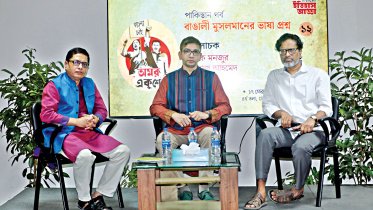


Speakers at The Daily Star’s Itihas Adda 12th session discussed the language dynamics of Bangalee Muslims during the Pakistan era, emphasizing that the discourse was multifaceted, encompassing considerations of power, geography, economy, and democracy. Writer and thinker Firoz Ahmed highlighted the complexity of debates surrounding Urdu and Sanskrit vocabulary, noting that it transcends simple Hindu-Muslim dichotomies. He referenced historical divisions within Bengal and challenged attempts to impose linguistic standards unilaterally, emphasizing that language evolution is organic and rooted in popular usage.
Firoz advocated for a balanced approach that preserves both Arabic-Persian and Sanskrit influences in Bangla, cautioning against extreme measures that could weaken the language. Mamun Siddiqui, a researcher at Bangla Academy, underscored the integral connection between the language issue and broader societal rights, such as land ownership, democracy, and economic empowerment. He stressed the significance of linguistic freedom in achieving full political autonomy and highlighted the grassroots support for Bangla as the state language beyond Dhaka’s elite circles.
Professor Tariq Manzoor from Dhaka University’s Bangla department discussed the evolving concept of “Bangalee Muslim” identity post-1947 and the challenges of reconciling spoken and written language norms. He noted the unsuccessful attempts to artificially alter Bangla’s linguistic structure post-Partition and emphasized the intrinsic link between language, demographic prevalence, and cultural heritage in determining state language status. Despite constitutional recognition in the 1950s, the practical implementation of Bangla as the state language lagged behind during the Pakistan era, reflecting the ongoing struggle for linguistic equality and representation.