
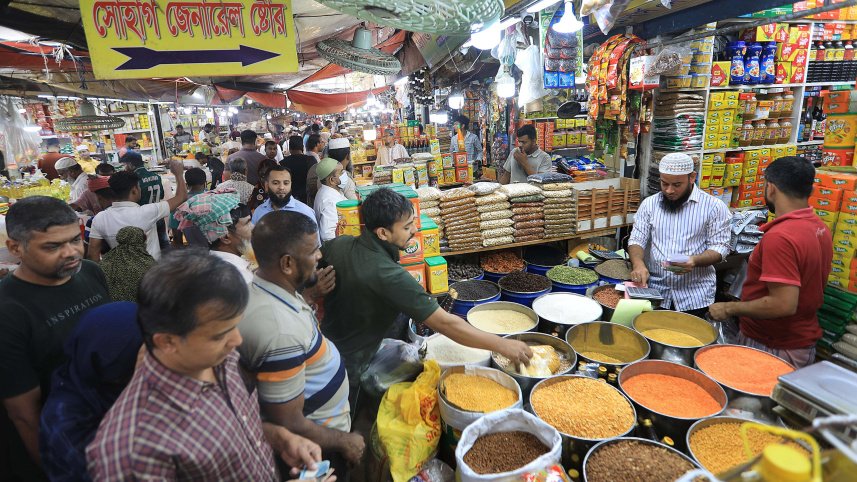


Prices of various essential commodities have decreased in the second week of Ramadan, offering some respite to consumers in Dhaka. Nevertheless, traders have highlighted that this significant drop is negatively impacting producers at the agricultural level.
A survey of kitchen markets in Shewrapara, Kazipara, Ibrahimpur, Farmgate, and Karwan Bazar revealed noticeable reductions in prices of vegetables, fruits, and certain protein items compared to the early days of Ramadan.
For instance, the cost of lemons, which previously ranged from Tk 150 to Tk 200 for four regular-sized fruits, has now decreased to Tk 100–120. Smaller lemons, previously priced at Tk 100–120 for four pieces, are now available for Tk 50–60, whereas the smallest ones have gone down from Tk 40 to Tk 30.
Similarly, cucumber prices have witnessed a decline. Local varieties that were priced at Tk 160 per kilogram are now being sold for Tk 120. Hybrid cucumbers, previously retailing between Tk 100 and Tk 120 per kilogram at Karwan Bazar and Mohammadpur Geneva Camp market, are now ranging from Tk 60 to Tk 100.
Tomato prices have also experienced a significant drop, falling from Tk 60–80 per kilogram to Tk 30–60.
Onion rates have notably decreased in retail markets. A customer at Shewrapara Bazar mentioned, “Before Ramadan, onions were Tk 200 for 3 kilograms. Today, I purchased the same quantity for Tk 120,” confirming the price surge at the start of Ramadan followed by a decline in the second week.
Retailers have observed that onions previously priced at Tk 60–70 per kilogram are now available at Tk 35–40, while potato prices have dwindled from Tk 20–25 to Tk 15–20 per kilogram.
Fruit prices have shown a similar downward trend. Sagar bananas are now priced at Tk 150–160 per dozen, down from Tk 180–200. Apples and malta prices have seen a decrease of approximately Tk 50 per kilogram from their earlier rates of Tk 350–380. Thai papaya, previously sold at up to Tk 200 per kilogram, is now priced between Tk 120 and Tk 160, while local varieties have dropped to Tk 80–100 from Tk 100–120.
In terms of protein items, beef prices have slightly eased, now ranging from Tk 750 to Tk 800 per kilogram compared to Tk 770–800 previously. Mutton rates remain steady at Tk 1,300 per kilogram.
Egg prices stand at Tk 100–120 per dozen, with broiler chicken prices decreasing from Tk 190–200 per kilogram to Tk 180–190. Sonali chicken prices remain unchanged at Tk 300 per kilogram.
Rice prices have remained stable, with wholesalers attributing this trend to a slight reduction in demand during the fasting month.
Saifur Rahman Chowdhury Sujan, the general secretary of the Karwan Bazar Brihattar Paikari Kacha Bazar Arot Byabasayi Malik Samity, commented that vegetable supplies are increasing while the customer influx is low, resulting in price drops. He emphasized the necessity of maintaining fair and reasonable prices to avoid detrimental impacts on farmers.
Trader Abul Kalam indicated that the production cost of onions in Faridpur this season was Tk 36–37 per kilogram. At the start of Ramadan, farmers sold onions at Tk 46–47 per kilogram, making profits. However, current farm-level prices have fallen to Tk 24–25 per kilogram.
Wholesale market reports suggest onions are selling at Tk 27–28 per kilogram in Dhaka, indicating a disparity between the reduced consumer prices and the losses faced by producers.
Potato trader Md Sabuj shared that they are buying potatoes from villages at Tk 7.5 per kilogram and selling them at Tk 10 per kilogram in the wholesale market, with labor and transport costs amounting to Tk 2.5 per kilogram. Despite retail prices in Dhaka ranging from Tk 15–20 per kilogram, farmers are experiencing losses of Tk 4–5 per kilogram.
Vegetable seller Md Mosharraf Hossain noted that prices of various Ramadan-related vegetables typically start high and decrease as demand wanes. This year, prices of onions and potatoes have seen sharper declines, along with lemons, green chilies, cucumbers, tomatoes, and eggplants as demand tapered off after the initial rush.