
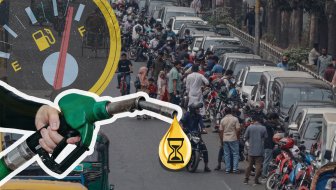


Bangladesh is in the process of securing significant external funding to ensure a stable supply of fuel and liquefied natural gas imports as the new administration under Prime Minister Tarique Rahman takes steps to stabilize the economy in the face of a challenging global energy landscape intensified by the Iran conflict.
With a population of 175 million, the country heavily depends on imports to meet 95% of its energy requirements, prompting state-run entities to increasingly engage with the volatile market to address the shortfall. While the government had implemented fuel rationing measures, these restrictions were temporarily relaxed during the Eid al-Fitr celebrations.
Rashed Al Mahmud Titumir, the prime minister’s financial and planning advisor, revealed that Dhaka is currently in discussions with major development financial institutions such as the Asian Development Bank, the World Bank, the International Islamic Trade Finance Corporation, and the Asian Infrastructure Investment Bank to secure additional funding.
Titumir expressed optimism about receiving approximately $1.3 billion from the International Monetary Fund through an existing program, in addition to an extra $250 million to $500 million on top of the roughly $500 million in budgetary assistance from the ADB.
The urgency to secure funding has heightened due to the escalating tensions in the Middle East, causing disruptions in global energy markets, price spikes, and concerns over supply routes.
To ensure a continuous flow of financing for oil and energy, Titumir emphasized the need to diversify procurement sources, including exploring options in the United States, Southeast Asia, Nigeria, and the Middle East, to reduce dependence on a single supplier.
Despite the surge in global prices, the government of Bangladesh has no plans to transfer the increased costs to consumers. Titumir affirmed that they are committed to providing necessary funding to prevent any economic contraction, relying on multilateral financial backing rather than private-sector loans.
Bangladesh routinely adjusts government-set fuel prices monthly based on a globally determined pricing mechanism.