
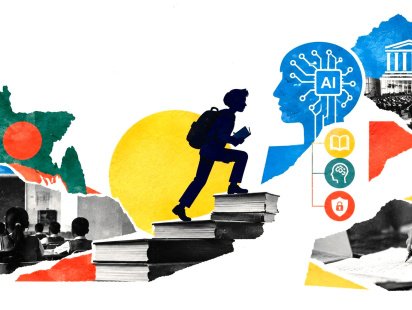


Bangladesh’s education discourse has recently taken an unforeseen yet positive twist. While governments worldwide are unveiling artificial intelligence initiatives, Education Minister A.N.M. Ehsanul Hoque Milon has advocated for a less trendy but more essential approach: children should first develop robust reading, critical thinking, and validation skills to effectively and safely utilize AI.
Minister Milon presented this argument at Unesco’s Digital Learning Week 2026 in Paris, where over 25 ministers and appointed education representatives endorsed a collective statement on upholding education as a universal right and a shared asset in the era of AI. His remarks were part of the session dedicated to age-appropriate AI.
His stance was distinctive as it resisted the prevalent push to equate technological integration with educational advancement. While acknowledging the inevitability of AI, Milon emphasized that its success should be gauged not by user numbers, pilot projects, or participating institutions but by educational outcomes, impact on teachers’ workloads, fairness, safety, and cost-efficiency. He emphasized the importance of involving teachers in decisions regarding pilots, procurement, evaluation, and rectification, cautioning against automated systems autonomously determining recruitment, promotion, or disciplinary actions.
This approach signifies a prudent de-escalation, neither dismissing AI nor urging Bangladesh to shy away from technological progress. It refrains from the rush to adopt technology and instead poses a fundamental question preceding every educational technology decision: what issue are we aiming to address, and what prerequisites must be in place for the technology to be beneficial?
Unesco’s roundtable also rejected the notion of technology as a one-size-fits-all solution. With a focus on “Sustaining the public purposes of education in the age of AI,” the ministerial discussions delved into safety, age suitability, procurement, actual ownership costs, and AI sovereignty. These concerns revolve around public authority rather than solely technical aspects. Who determines a child’s readiness for AI use? Who manages student data? What criteria must vendors meet before entering educational institutions? Can a ministry audit a system, comprehend its complete cost structure, and disengage without compromising data integrity or becoming reliant on a single provider?
The resulting joint statement endorsed by 25 education ministers advocates for transparent systems, teacher engagement, developmentally appropriate utilization, safeguarding learner data, inclusive design, multilingual considerations, and comprehensive cost assessment. It demands that providers demonstrate educational value before implementation and accept responsibility for any negative consequences. Crucially, it underscores that AI should not supplant human interactions and professional judgment in the learning process.
These principles are timely as Bangladesh gears up to incorporate AI, robotics, machine learning, and cybersecurity more prominently in textbooks for grades 6 to 10. While introducing students to emerging technologies is sensible, ensuring they possess the requisite literacy, numeracy, and critical thinking skills to grasp these concepts is paramount. Without these foundational skills, an AI curriculum could foster reliance on tools whose outputs students cannot question.
Bangladesh’s Five-Year Strategic Framework for Reform and Development highlights learning poverty—defined as the incapacity to read and comprehend a simple text by age ten—at 50 percent and aims to diminish it to 25 percent by FY2030 and 22 percent by FY2031. This target should serve as the initial milestone of the national AI strategy.
A ten-year-old lacking the ability to understand a basic passage in Bangla will struggle to independently evaluate AI-generated information. AI tools may generate coherent yet inaccurate responses, necessitating reading comprehension, subject knowledge, and the confidence to challenge machine-generated content. Foundational learning is no longer merely a prerequisite for traditional schooling but serves as the primary layer of AI proficiency.
This connection underscores the government’s next steps. The most urgent intervention for AI readiness may involve ensuring that every struggling learner receives structured support in reading and numeracy. A recent roundtable organized by The Daily Star emphasized that remedial education should be integrated into routine classroom instruction, teacher training, assessments, mentoring, and the forthcoming Primary Education Development Programme (PEDP), rather than relying on short-term initiatives. Participants stressed the importance of teachers identifying which students lag behind, in which subjects, and by how much before implementing remedial measures.
This model should be methodically implemented, encompassing regular diagnostic assessments in schools, dedicated time for remedial teaching, personalized instruction based on individual student levels, appropriate Bangla reading materials, teacher mentorship, and additional support where staffing is inadequate. Success should be measured by educational progress, particularly among marginalized students, rather than by expenditure, material distribution, or training sessions completed.
Subsequently, AI tools could be trialed as supplements to teachers, aiding in identifying learning gaps, customizing instructional materials, and streamlining routine administrative tasks. Pilot programs should disclose costs, data handling procedures, compare outcomes against credible alternatives, and encompass rural, low-income, and Bangla-medium schools. Teachers must actively participate in designing and evaluating these tools, rather than being passive recipients.
Equal emphasis should be placed on cost