
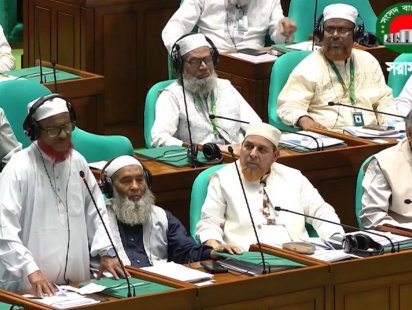


Jamaat-e-Islami legislators strongly criticized the BNP in parliament today, questioning the party’s assertion of being a “Liberation War party” and accusing the ruling party of neglecting national crises. The debate during the motion of thanks to the president’s address saw a call for the implementation of Qur’anic law.
ATM Azharul Islam, a Jamaat-e-Islami MP and Nayeb-e-Ameer, raised doubts about the BNP’s claim to be a “Liberation War party” given that it was founded in 1978, well after the 1971 Liberation War. He emphasized the presence of freedom fighters in both BNP and Jamaat-e-Islami.
Azharul posed questions on the irony of a party that fought against a fascist regime and attained power through elections expressing gratitude to a president associated with that regime. He questioned the motivations behind such actions, hinting at potential ulterior motives.
Addressing the issue of women’s leadership within BNP, Azharul expressed surprise at the nomination of the Women’s League Forest and Environment Secretary from Kashiani Thana in Gopalganj for a reserved women’s seat, raising eyebrows about the selection process.
On the topic of security concerns, Azharul suggested the introduction of a “security card” to address the reported attacks by ruling party supporters. He highlighted instances of assaults faced by himself and party workers, emphasizing the need for enhanced protection in the current political climate.
Jamaat-e-Islami MP Rafiqul Islam Khan accused the ruling party of sidelining critical national problems like the fuel crisis, escalating fuel costs, and deteriorating law and order, focusing instead on targeting the opposition relentlessly.
Rafiqul reminded the assembly of Jamaat’s unwavering support to BNP following the 1991 elections and stressed the historical alliance between the two parties. He reflected on missed opportunities for significant political shifts, criticizing BNP’s inaction during crucial moments.
Turning to the present government, Rafiqul cautioned against mirroring the Awami League’s governance style, emphasizing the need for a more inclusive and balanced approach for national welfare. He raised concerns about the government’s alignment with a particular political tone, potentially limiting democratic principles.
In summary, the Jamaat-e-Islami lawmakers highlighted discrepancies in the BNP’s identity claims, criticized the ruling party’s focus on opposition attacks over national issues, and called for a more inclusive and strategic approach to governance for the benefit of the country.