
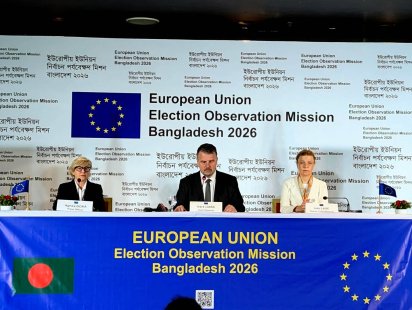


The European Union Election Observation Mission (EU EOM) today hailed the 2026 parliamentary elections in Bangladesh as a significant step towards reinstating democratic governance and the rule of law. Chief Observer Ivars Ijabs, presenting the mission’s final report in Dhaka, commended the polls for being genuinely competitive for the first time since 2008, with fundamental freedoms widely upheld.
Despite acknowledging the elections as “credible” and “competently managed”, the EU EOM pointed out instances of “sporadic localised political violence” and a lingering “fear of mob attacks” fueled by manipulated online narratives, which marred certain aspects of the democratic process. The mission also raised concerns about the limited political space for women, emphasizing that their restricted participation hindered inclusivity.
Chief Observer Ijabs highlighted that the credible electoral process helped reinvigorate democracy and put forward 19 recommendations, including six priority measures aimed at enhancing the integrity of future elections. Key proposals encompass revising the legal framework for parliamentary polls, ensuring transparent vote tabulation at local levels, and amending the Representation of the People Order to ensure 33 percent women’s representation in all internal party committees by 2030.
Additionally, the EU EOM suggested requiring political parties to field at least one-third women candidates in national and local elections. The mission also proposed amending the Cyber Security Ordinance to impose binding obligations on social media platforms, strengthening campaign finance regulations, and broadening postal voting eligibility to encompass homebound voters, individuals with disabilities, internally displaced persons, migrant workers, and students.
The report praised the Bangladesh Election Commission for its independent and transparent operation, which instilled stakeholder confidence and upheld the election’s integrity. The peaceful polling day, transparent tabulation process, and widespread acceptance of the results exemplified how a credible election could rejuvenate democracy, as outlined in the report.
With 223 observers deployed, the mission noted that the elections were conducted under a revised legal framework aligned with international standards, with recent amendments enhancing inclusion and credibility. However, the framework was deemed fragmented and in need of further reform to bolster legal certainty, close loopholes, and eliminate provisions that could unduly restrict freedom of expression.
While commending the commission’s efforts to rebuild public trust and engage with political parties, the report highlighted inconsistent enforcement of newly introduced campaign rules, potentially creating perceptions of bias and an uneven playing field. The preparations for election day were characterized as professional and timely, with a significant number of overseas voters participating by post and extensive training provided to polling staff.
Vote counting and tabulation were handled competently, although the report recommended strengthening safeguards during these processes. It also noted the slow dissemination of nationwide results in an analog format, limiting public access to timely election data. The commission addressed 645 appeals on candidate nominations, reinstating a majority of initially rejected applicants.
The report mentioned that approximately 2,000 candidates contested the polls, with alliances led by BNP and Jamaat emerging as the main contenders among 51 parties. Women accounted for just under four percent of the total candidates, according to Ijabs.
The EU EOM identified 23 cases of disinformation and digital attacks targeting minorities and women activists, attributing misleading content mainly to partisan influencers and deceptive media accounts, some operating from outside Bangladesh. Regarding campaign finance, the report criticized existing regulations as outdated and ineffective, advocating for enhanced verification and oversight mechanisms.
Lastly, Ijabs commended the “revitalized civic space” post the July uprising, acknowledging the role of grassroots initiatives in reinstating public trust in the electoral process.