
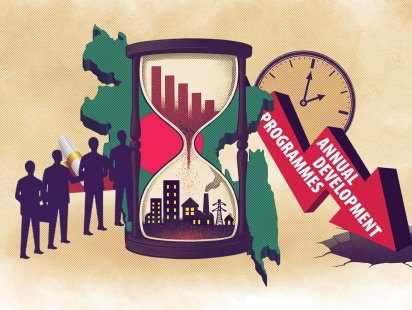


Bangladesh has experienced a challenging year in executing its Annual Development Programme (ADP). Recent data from the Implementation Monitoring and Evaluation Division (IMED) indicates that only 67.5 percent of the revised ADP was implemented in the fiscal year 2025-26, marking the lowest implementation rate in 53 years. The previous fiscal year also concluded with a significantly low implementation rate of 67.85 percent. These figures shed light on the resilience of Bangladesh’s development governance.
A broader perspective reveals that Bangladesh achieved implementation rates of 92.79 percent in FY2021-22, 84.16 percent in FY2022-23, and 80.63 percent in FY2023-24. However, there was a notable decline in implementation over the subsequent two fiscal years, hovering around 68 percent. The shift from strong implementation to weaker performance over the past years raises questions about the vulnerabilities in Bangladesh’s development governance.
One can attribute the recent challenges to the extraordinary circumstances that Bangladesh has faced, including the political transition in August 2024, macroeconomic pressures, foreign exchange shortages, and fiscal constraints. These factors put immense strain on Bangladesh’s public investment system. While acknowledging the context of these challenges, it is crucial to assess how effectively the public investment system responded to these shocks while continuing to drive development initiatives.
The recent implementation slowdown should not be isolated to recent events alone. Preceding the political transition, issues such as procurement delays, unresolved land acquisition, coordination gaps among implementing agencies, and project management limitations were identified by government reviews and development partners. These long-standing weaknesses were magnified by the recent shocks, underscoring the need for resilient institutions to support Bangladesh’s development goals.
The historic low in implementation this year signifies more than just a statistical setback. It underscores that development governance is tested during periods of stress, revealing the need for institutions that can withstand disruptions. The focus should not solely be on implementation speed but on the entire decision-making process leading up to implementation.
Resilient development governance hinges on realistic financing, institutional capacity, and project readiness. Challenges in revenue mobilization, external financing, and project preparedness impact development spending. Ensuring that projects are well-prepared before implementation begins is essential for resilience in public investments.
International development practices increasingly emphasize strengthening public investment management over expanding spending. The focus is on effectively selecting, financing, preparing, implementing, and monitoring investments throughout the project cycle. The ability to deliver during crises defines strong public investment systems.
Bangladesh’s development trajectory is evolving, with larger and more complex public investments necessitating capable institutions to manage uncertainties. While larger budgets and ADPs are important, success lies in the ability of development governance to deliver amidst future shocks.
The latest IMED data should prompt a reevaluation of how Bangladesh plans, finances, and governs public investment. Strengthening development governance is essential to support the country’s growing development aspirations. This challenging period could serve as a pivotal moment towards building more resilient development governance.