
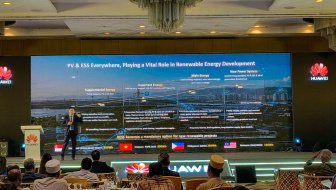


Huawei introduced Bangladesh’s inaugural grid-forming smart string inverter and extensive battery energy storage system on the previous day. The initiative aims to enhance renewable energy utilization and address grid stability challenges in the nation.
The Chinese tech giant revealed the SUN2000-506KTL-H3 grid-forming smart string inverter and LUTERRA-6261-25 battery energy storage system during an event themed “Grid-forming technology powering a greener future” at InterContinental Dhaka. The occasion assembled government representatives, power industry stakeholders, independent power producers, investors, technical advisors, and engineering, procurement, and construction contractors.
Will Yu, Huawei’s Managing Director for South Asia Digital Power Department, emphasized the growing significance of integrating solar power with battery storage amid the global transition towards renewable energy sources. He highlighted the necessity of intelligent storage and grid-forming technologies to ensure the availability of clean energy on demand.
Huawei pledged its commitment to aiding Bangladesh in constructing a more intelligent, resilient, and sustainable power infrastructure through solar-plus-storage solutions. The company touted the capabilities of its latest inverter, which can enhance grid stability by regulating voltage and frequency, delivering increased power output, reliability, operational ease, maintenance efficiency, and safety.
In contrast to traditional inverters that adhere to existing grid parameters, a grid-forming inverter actively establishes and sustains voltage and frequency levels. This functionality is crucial as the grid integrates more solar and renewable energy sources. The accompanying LUTERRA-6261-25 battery storage system boasts a 92.6 percent round-trip efficiency, ensuring effective electricity storage and retrieval.
The system incorporates safety features, individual battery cell monitoring, and rapid response mechanisms to support grid requirements promptly. Wang Junfeng, Huawei’s Chief Technology Officer for Asia Pacific Digital Power Business, shared the company’s insights on global renewable energy trends during the event.
Huawei emphasized the benefits of coupling solar generation with battery storage, enabling surplus daytime electricity to be stored and utilized during peak demand periods in the evening. Additionally, the system aids in managing solar output fluctuations, balancing grid frequency, supporting voltage stability, and providing diverse grid assistance functions.