
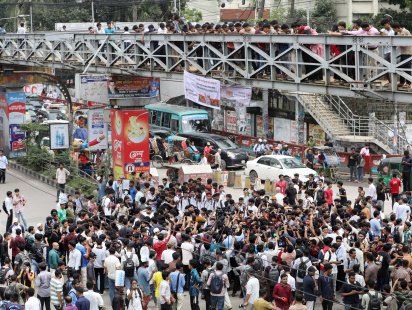


A potential risk looms over the protest related to this year’s Higher Secondary Certificate (HSC) and equivalent examinations being oversimplified as mere youthful discontent. The validity of the candidates’ complaints cannot be disregarded. It was concerning when candidates had to navigate through deep floodwaters in Dhaka and other districts under heavy rainfall to reach their exam centers after the Chattogram education board postponed the exams. The decision made by the authorities seemed inflexible and lacking in compassion. Moreover, a purported private comment by the education minister likening the candidates to fearful broiler chickens added fuel to the fire.
The HSC exam holds substantial importance as a pivotal assessment that shapes the future academic and career paths of students. In an effort to ensure the exams reflect the true abilities of students, the government opted to modify the assessment methods. However, students felt inadequately prepared for these changes. The adverse weather conditions introduced extraneous factors that could impact the fair evaluation of students’ knowledge and skills.
Examinations like the HSC, with high stakes involved, necessitate meticulous handling. In this technologically advanced era where accurate weather forecasts are readily available on mobile phones, the assertion that competent authorities misjudged the monsoon season is questionable. The recent exam debacle highlighted the deficiency in our public examination system, lacking an effective emergency protocol tailored to address regional, center-specific, and individual candidate issues proactively.
The crisis escalated when the education minister acknowledged in parliament that there were errors in some questions in the Physics First Paper exam, promising full marks to those who attempted to answer them. While this corrective measure is crucial, it does not fully rectify the situation. Candidates might have wasted valuable time attempting the erroneous questions, impacting their exam experience, confidence, and focus. Notably, four teachers responsible for formulating and moderating the questions received show-cause notices, emphasizing the need for stringent quality control in exam setting.
A political undertone is discernible in the issue, with authorities attributing the decline in standards to the preceding government’s policies like “auto-pass,” truncated syllabi, and inflated results. The current administration aims to restore credibility by implementing stricter examination procedures. However, the sudden imposition of excessively challenging questions or altered patterns without adequate preparation is unfair to students who were not adequately guided to develop the requisite skills during their studies.
To address the root issues, the government must initiate reforms encompassing curricula, textbooks, classroom instruction, teacher training, and formative assessments. The curriculum should be designed to align with students’ experiences and foster a holistic educational journey rather than focusing solely on employment-driven objectives. Pilot testing proposed changes before implementation is crucial to avoid unforeseen complications, as evidenced by the flawed transition to a unified question paper system resulting in a national crisis due to a single error.
The handling of the situation deteriorated as student protests spiraled out of control, disrupting city life for almost two days. The diverse demands within the student groups, ranging from calls for the education minister’s resignation to specific proposals for retests and improved exam conditions, underscore the lack of a unified student stance. This multifaceted protest comprised aggrieved examinees, spontaneous participants, organized leaders, and political opportunists exploiting the discord for personal gain.
Drawing from recent events, where student activism influenced policy changes, it is evident that protests can drive policy amendments. However, the challenge lies in preventing every administrative disagreement from escalating into a removal campaign. This misinterpretation of democratic engagement as a conspiracy hinders constructive dialogue and resolution.
When resignation becomes the immediate recourse for holding protesters accountable, institutions forego the opportunity for introspection and improvement. Conversely, dismissing protesters as pawns in a political game undermines the legitimacy of legitimate grievances.
In conclusion, Bangladesh requires a balanced approach that neither compromises on standards nor employs harsh measures. A reevaluation of the assessment system is imperative, necessitating the establishment of an independent national assessment council proficient in curriculum alignment, psychometrics, subject evaluation, and exam security. Introducing significant question design changes should undergo pilot testing, teacher consultation, and transparent communication well in advance to mitigate unforeseen challenges. Students must differentiate between advocating for fairness and resorting to coercion, while the government should avoid authoritarian attitudes and baseless conspiracy theories.
The key takeaway from this episode is the significance of upholding genuine standards through consistency, transparency, and empathy. Examinations can be rigorous without being punitive. The exam disruptions unveiled not just a drainage flaw but a deficiency in care, fostering a confrontational atmosphere. Rectifying this culture demands maturity from all stakeholders before expecting the same from the students.