
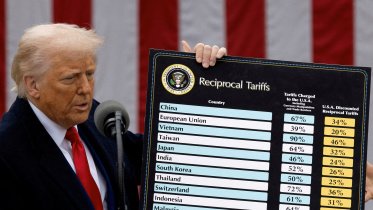


The US Supreme Court on Friday invalidated President Donald Trump’s broad tariffs imposed under a law intended for national emergencies, marking a significant ruling with global economic implications. In a 6-3 decision authored by conservative Chief Justice John Roberts, the justices upheld a lower court ruling that deemed the use of the 1977 law by the Republican president as exceeding his authority.
The court determined that the Trump administration’s interpretation of the International Emergency Economic Powers Act (IEEPA) to justify imposing tariffs encroached on Congress’s powers and violated the “major questions” doctrine, a legal principle requiring clear congressional authorization for actions of significant economic and political impact. Chief Justice Roberts cited a prior Supreme Court ruling, stating that the president must have clear congressional authorization to impose tariffs, which Trump lacked.
Trump had utilized tariffs as a strategic tool in economic and foreign policy, sparking a global trade conflict that unsettled trading partners, impacted financial markets, and created economic uncertainty. The Supreme Court’s decision came in response to a legal challenge by affected businesses and 12 US states, predominantly led by Democrats, against Trump’s unilateral imposition of import taxes using the IEEPA.
The dissenting justices were conservative Clarence Thomas, Samuel Alito, and Brett Kavanaugh. Joining Chief Justice Roberts in the majority were conservative Justices Neil Gorsuch and Amy Coney Barrett, as well as the three liberal justices. The Supreme Court, with a 6-3 conservative majority, had previously supported Trump in emergency decisions following his return to the presidency in January 2025.
The Supreme Court’s ruling could potentially require the refunding of more than $175 billion collected under Trump’s IEEPA-based tariffs. Trump’s administration had bypassed Congress’s authority to impose tariffs by invoking the IEEPA, a move unprecedented in presidential history. The law, usually utilized in national emergencies, allowed Trump to aggressively assert executive authority in various domains, including immigration, military operations, and trade policy.
Trump defended his tariffs as essential for US economic security, arguing that without them, the country would be vulnerable to exploitation by other nations. Despite Trump’s assertions, the Supreme Court’s decision may necessitate alternative legal justifications to maintain some tariffs. These alternatives, such as national security provisions and retaliatory actions against unfair trade practices, could fall short of replicating the broad reach and immediacy of Trump’s tariff powers.
The use of tariffs as a diplomatic tool by Trump, while effective in some instances, has strained relationships with traditional US allies and sparked global trade tensions. The IEEPA’s historical application focused on sanctions rather than tariffs, leading to legal challenges and scrutiny over Trump’s tariff policies. The Congressional Budget Office projected substantial revenue generation from the existing tariffs, including those imposed under the IEEPA, over the next decade.
In summary, the Supreme Court’s ruling against Trump’s use of the IEEPA for tariffs underscores the limits of presidential authority in trade policy and signals a potential shift in US trade relations and economic strategy moving forward.