
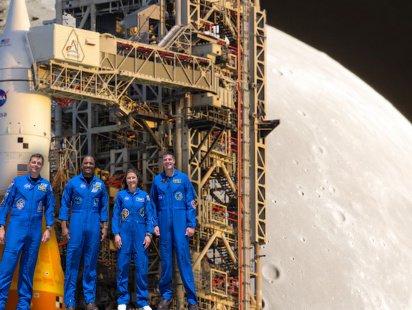


Ever since the conclusion of the Apollo missions, the moon has remained a focal point of our cosmic exploration. NASA has recently initiated the Artemis II mission using the Orion spacecraft to transport astronauts back to lunar orbit. Traveling at a speed 32 times faster than sound, the crew could traverse Bangladesh in less than a minute. The astronauts are embarking on a 10-day expedition as NASA aims to establish a lunar base by 2028.
Here are 5 key aspects to understand about this significant cosmic endeavor.
**Decades of Anticipation**
This marks the first human voyage to the moon since the final Apollo mission in 1972. For many individuals today, witnessing humans orbiting the moon in real-time is a novel experience. By intertwining nostalgia with cutting-edge technology, this journey reinstates the moon as a shared spectacle for all.
**Diverse Crew Composition**
In contrast to past missions, this endeavor underscores the strides taken to make space exploration more inclusive. The crew comprises astronauts Christina Koch and Victor Glover, who bring fresh perspectives to modern exploration, alongside Jeremy Hansen from Canada. This selection signifies a move towards a future where a variety of voices and communities can aspire to explore beyond Earth.
**Unprecedented Rocket Power**
The team is utilizing the Space Launch System (SLS), recognized as the most potent rocket in existence. It generates a staggering 8.8 million pounds of thrust upon liftoff, equivalent to the power of 160,000 Corvette engines igniting simultaneously. It stands as the powerhouse of the cosmos.
**Enhanced Lunar Imaging**
Gone are the days of grainy moon footage from the last century. Artemis II is equipped with cutting-edge cameras to transmit ultra-high-definition images and videos back to Earth. This technology provides a front-row view of the lunar surface in stunning 4K quality or higher, offering a detailed look at the craters and celestial scenery.
**Preparation for Mars Exploration**
NASA’s return to the moon is not just a brief visit; it serves as a crucial training ground for the forthcoming journey to Mars. Artemis II serves as a pivotal test for the technology that will, hopefully, propel humans to Mars in the 2030s. Each mile traversed brings humanity closer to becoming a multi-planetary species.
As the world gazes skyward, we are reminded that no expanse is insurmountable. The moon signifies merely the prologue to a grander narrative awaiting all of us.