
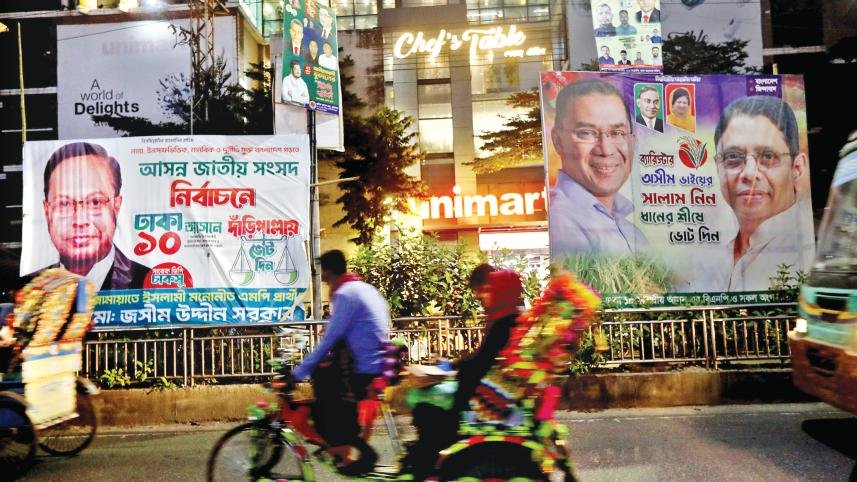


Posters and promotional materials of aspiring candidates from various political parties are causing a disturbance in the capital city as the national elections approach in February, in breach of current regulations. These campaign materials are now visible on almost every surface like utility poles, footbridges, building walls, and metro rail pillars, with party symbols and slogans becoming increasingly prominent.
The Election Commission prohibited the display of posters during the official campaign period starting on June 19 to ensure a more environmentally friendly and organized election process. The campaign period is set to kick off in the first week of the upcoming month following the announcement of the election schedule.
Authorities and locals have noted that candidates are taking advantage of the pre-schedule period to exhibit campaign materials. While most of these materials belong to BNP hopefuls, candidates from Jamaat-e-Islami and several smaller parties such as Khelafat Majlish, Gano Sanghati Andolon, Amar Bangladesh Party, Gano Adhikar Parishad, Bangladesh Jatiya Party, Bangladesh Biplobi Workers Party, and the Communist Party of Bangladesh are also visible throughout the city.
During inspections in areas like Farmgate, Indira Road, Manik Mia Avenue, Mirpur Road, Dhanmondi, Segunbagicha, Purana Paltan, Bijoynagar, Motijheel, Gulistan, Kakrail, Moghbazar, Karwan Bazar, Uttara, Gulshan, and Mirpur, an abundance of posters was observed.
In response to the situation, the Dhaka North City Corporation (DNCC) issued a notice directing residents to remove unauthorized boards, posters, banners, billboards, and LED displays within a week to avoid eviction drives and potential fines or legal actions.
The Graffiti Writing and Poster Sticking Control Act of 2012 restricts posters from being displayed outside designated areas, with penalties of up to Tk 10,000 or 30 days in jail. Failure to pay fines can result in an additional 15 days of imprisonment, and offenders are required to remove the posters at their own cost. Those who benefit from unlawful posters may face fines ranging from Tk 10,000 to Tk 50,000 or similar jail sentences.
Despite the regulations in place, violations continue to persist. Officials from the DNCC and Dhaka South City Corporation (DSCC) acknowledged the challenges they face in curbing these illegal practices despite conducting regular crackdowns.
Adil Mohammad Khan, president of the Bangladesh Institute of Planners, highlighted the weak enforcement of laws in Bangladesh despite the country having specific legislation that other nations lack. He stressed the need for clear rules regarding the use of physical posters in today’s digital era, emphasizing the importance of accountability to deter repeated violations.
Khan also emphasized the necessity for stronger social accountability, suggesting that illegal posters should result in negative publicity to discourage their use. DNCC Administrator Mohammad Azaz expressed the corporation’s efforts to remove posters daily, urging leaders to utilize digital platforms instead. He mentioned that punitive actions would be taken if necessary.
Air Commodore Md Mahabubur Rahman Talukder, Chief Waste Management Officer at DSCC, indicated that stricter measures would be discussed with senior authorities soon to address the issue at hand.