
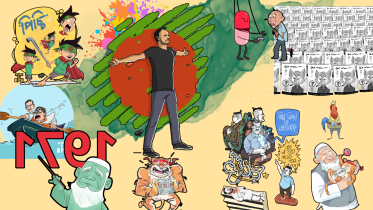


During the July Uprising, cartoonists played a crucial role in unmasking the true nature of authoritarianism. Many of them faced imprisonment under the controversial Digital Security Act during the oppressive regime. Despite these challenges, they persisted in using their art to expose corruption, absurdity, and injustice. Their caricatures served as a potent tool, cutting through fear and censorship to reveal truths that words alone often could not convey.
However, even post-movement, the realm of political cartooning remains restricted, particularly during election periods. Some cartoons now appear to serve more as tools for promoting specific parties rather than critiquing the system. Amidst the unfolding political turmoil, a lingering question emerges: why is there a lack of interest among cartoonists in addressing election-related matters through their artwork?
To delve deeper into this issue, we engaged in discussions with four cartoonists to grasp their passion for political cartoons and the factors motivating them to persist in this demanding field, despite the uncertainties.
In numerous countries, political leaders communicate in measured, diplomatic tones, while cartoonists derive their satire from the underlying implications of these carefully chosen words—deciphering hidden meanings and exposing contradictions through nuanced commentary. When leaders are more straightforward, the creative process becomes more straightforward and immediate. However, in Bangladesh, the space for expression remains restricted. The limitations on what can be expressed and how it can be articulated continue to influence the tone and extent of political satire.
Mehedi Haque, Senior Cartoonist at The Daily New Age and Executive Editor of UNMAD, candidly discussed the risks faced today.
His sentiments reflect a broader reality: political cartooning in Bangladesh has evolved beyond being merely an artistic pursuit. It has become an act of public accountability, necessitating courage, self-restraint, and a constant balancing act between freedom of expression and personal safety.
“My newspaper frequently receives legal notices or direct calls concerning my cartoons. Nonetheless, this does not sway either my newspaper or myself. We stand by what we believe is right. Other pressures manifest in various forms. For instance, my friends and family are consistently anxious about the potential risks associated with my profession, and paid commentators continually strive to discredit me on social media. However, I seldom pay heed to such remarks,” Mehedi elaborated.
For many cartoonists, the challenges extend beyond legal risks to a pervasive culture of pressure, surveillance, and public animosity.
Morshed Mishu, Cartoonist and Assistant Editor at UNMAD, highlighted a different struggle—creative fatigue influenced by the political realities at play. “I tried to recollect the last time I created a political cartoon. I believe it was following the attack on Nur. Since then, I have refrained from drawing any cartoons related to the present election. The statements and actions of the figures involved already bear such resemblance to caricatures that I feel there is little left for me to portray. Political cartoons typically operate on multiple layers—diverse angles, perspectives, subtle commentary—yet here, everything is already so overt.”
Natasha Jahan, an artist at The Business Standard, expressed emotional exhaustion. “Honestly, I would say I’ve become disheartened. I am no longer the same person I once was. The environment is truly disheartening. Those whom I once held in high regard, whom I respected, have all changed. Now, whom should I hold accountable? Whom should I blame? I believe it’s our own fault—we misplaced our trust in the wrong individuals. Nonetheless, I strive not to be entirely self-driven. Gradually, I try. Yet, the envisioned progression in cartoons has not materialized. That kind of environment is elusive.”
Zahidul Haque Apu, a Freelance Cartoonist and Senior Manager of Content at Hoichoi Bangladesh, highlighted another structural hurdle. “Typically, I don’t produce political cartoons on a regular or professional basis. Perhaps some cartoonists lost interest due to the lack of recognition for their contributions. Artists, whether political or non-political, anticipate acknowledgment, akin to a musician or writer. When this acknowledgment is absent, motivation wanes. This potentially explains the low participation of political cartoonists in this election, despite the presence of numerous talented individuals producing exceptional work.”
Beyond motivation and recognition, political cartoonists in Bangladesh continue to navigate a landscape shaped by risks—be it legal, social, or personal. Natasha Jahan underscored how criticism often transitions into personal attacks.
Morshed Mishu narrated the constant labeling that follows political commentary. Even indirect pressures can significantly influence artistic decisions.
Despite these constraints, each artist recounted works that held profound personal significance—instances where their illustrations encapsulated their emotions and reflected the prevailing political atmosphere.
“There are numerous instances, but focusing on election cartoons, I recall one from 2014, following the Awami League’s triumph. In that cartoon, the ballot box was depicted as Aladdin’s lamp, with the Chief Election Commissioner emerging from it like a genie